




Slip rings – how they work and how to choose one
A slip ring transfers power, signals and data between a stationary and a rotating part, without twisting the cables. This guide explains how it works, which types exist and what to look for when choosing one.
 By Erik Ahlqvist, Managing Director of SCN · Updated 24 October 2026 · 6 min read
- Slip ring – a rotary electrical joint. Brushes in the stationary part slide against rings on the rotating part.
- Needed for unlimited rotation – more than a few turns in one direction, where a cable would otherwise twist off.
- Types – capsule, through bore, pancake and miniature, plus versions for Ethernet, fibre, high current and air or fluids.
- Choose by number of circuits, current and voltage, signal type, speed, environment and dimensions.
- Data needs the right design – fieldbus and Ethernet require slip rings built for them.
What is a slip ring?
A slip ring consists of a rotor and a stator. The rotor carries rings of brass or copper, often plated with gold or silver. The stator holds brushes that press against the rings. Each ring and brush forms one circuit, so a slip ring with 12 rings can transfer 12 separate conductors.
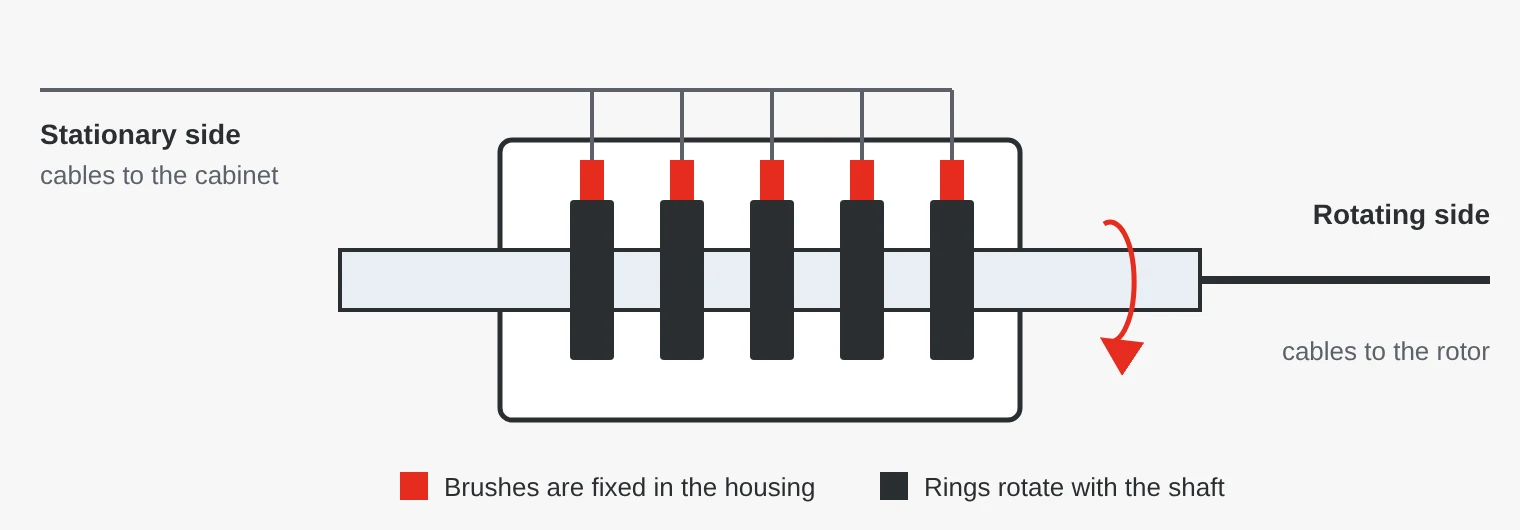
As long as a motion only goes a few turns back and forth, a cable chain or cable reel is often enough. When something has to rotate continuously, such as a rotary table, a camera or the hub of a wind turbine, you need a slip ring. It is also called a rotary electrical joint or electrical swivel.
Brushes are often precious metal for signals and silver graphite for high currents. Fibre brushes, bundles of thin metal wires, give several contact points per ring, less wear and lower noise.
Which types of slip ring are there?
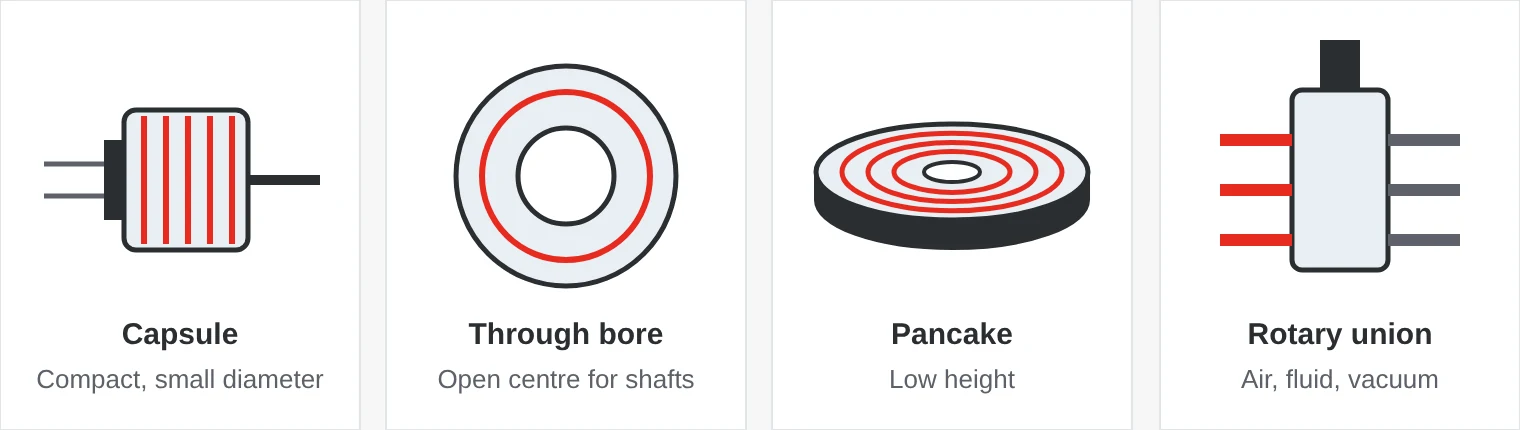
| Type | Features | Typical use |
|---|---|---|
| Capsule | Compact, small diameter, cables out at both ends | Cameras, small robots, measuring tables |
| Through bore | Hollow shaft so a shaft, hose or cable can pass through the centre | Rotary tables, packaging machines, wind turbines |
| Pancake | Flat, the rings lie in one plane | Where height is limited |
| Miniature | Few circuits, low current, very small size | Instruments, small gimbals, lab equipment |
| Ethernet and fieldbus | Circuits designed for high data rates | Robots, cameras, rotating machines with I/O |
| Fibre optic rotary joint | Carries light in an optical fibre, immune to interference | Radar, defence, underwater vehicles |
| Rotary union | For compressed air, fluids or vacuum, can be combined with electrical circuits | Filling machines, grippers, manufacturing |
What should you look for when choosing a slip ring?
- Number of circuits – count power, signals and data separately, and add a few spares.
- Current and voltage per circuit – for high currents, several rings can be connected in parallel.
- Signal type – weak analogue signals, for example from load cells, need gold-on-gold contacts and shielding. Ethernet and fieldbus need circuits designed for them.
- Speed – given in revolutions per minute. A miniature slip ring may handle a few hundred rpm, while a wind turbine slip ring is built for low speed and long service.
- Service life – given as a number of revolutions and depends on speed, current and contact material.
- Electrical noise – the variation in contact resistance as the ring rotates, given in milliohms. Important for sensor signals.
- Environment – IP rating, temperature, vibration, salt and condensation. IP40 is fine indoors, outdoors and in wind turbines IP65 is often required.
Where are slip rings used?
- Wind power – the slip ring between nacelle and hub carries power to the pitch motors and signals and CAN bus to the blade control system.
- Packaging and food – rotary filling and labelling machines, often with a rotary union for compressed air.
- Robots and automation – robot joints, rotary tables and automated vehicles with a rotating top.
- Mobile machinery – cranes and excavators whose upper structure can rotate without limit.
- Cameras and surveillance – PTZ cameras that turn 360° without stopping while sending video.
- Defence and radar – radar antennas, sensor turrets and antenna positioners with coaxial RF rotary joints and fibre.
- Medical technology – CT scanners, where the X-ray tube and detectors rotate continuously around the patient.
Five common mistakes
- Ethernet through ordinary signal rings. It may work on the bench but drop packets in operation. Choose a slip ring specified for the protocol and data rate.
- Mounting the stator rigidly. If both rotor and stator are clamped, the smallest misalignment loads the bearings. Hold the stator with an anti-rotation arm that allows some movement.
- Wrong contact material. Weak signals need gold. High currents need a material that handles the heat, such as silver graphite.
- Mixing power and signals. Interference from motor circuits can couple into sensor signals. Separate and shield them.
- Forgetting the environment. An IP40 slip ring will not last outdoors. Consider condensation, dust, salt and temperature.
Slip rings from SCN
We carry slip rings from Jinpat: miniature and pancake slip rings, slip rings for servo systems and wind turbines, versions for USB, HDMI and SDI, coaxial RF rotary joints and pneumatic rotary joints. Slip rings often need adapting, so start with a list of requirements: circuits, current, signals, speed, environment and dimensions.
Examples from our range
 JinpatWind turbine slip ringsFor power, signals and CAN bus to the blade control system. Power rings up to 63 A, IP65.View product →
 JinpatLPT012A-0602 Through bore slip ringThrough-bore slip ring with a 12.7 mm bore, six 2 A circuits and multiple contact points per ring for low noise.View product →
 JinpatLPFO-01A Fiber Optic Slip RingFibre optic rotary joint for high data volumes, IP65/IP68 and −45 to 85 °C.View product →
Erik Ahlqvist is Managing Director of SCN and has spent more than 20 years helping industrial companies choose the right electronics for demanding environments. He holds a BSc in Electronics from KTH Royal Institute of Technology, Stockholm.
LinkedIn profileFrequently asked questions
What is the difference between a slip ring and a commutator?
A slip ring has continuous rings and transfers the current unchanged. A commutator has segments that reverse the current direction as the rotor turns, as in a brushed DC motor.
Can you send Ethernet through a slip ring?
Yes, with a slip ring designed for Ethernet. Check which data rate it is specified for, such as 100 Mbit/s or 1 Gbit/s.
How long does a slip ring last?
Service life is given as a number of revolutions and depends on speed, current, contact material and environment. Fibre brushes and precious metals extend it.
What is a slip ring motor?
An induction motor whose rotor winding is connected through slip rings to external resistors. This gives high starting torque and low starting current, and is used in cranes and crushers, for example.
Are there contactless slip rings?
Yes. They transfer power and data inductively, capacitively or optically, without brushes that wear. They are used in CT scanners, among other things.
Do you have a rotating design that needs power, signals or data? Ask us – you get an answer within 24 hours.
Ask us