




Relay vs contactor vs SSR – which should you choose?
A relay, a solid state relay (SSR) and a contactor all switch a load on and off with a small control signal. The right choice depends on current, voltage, how often you switch and whether the load runs on AC or DC.
 By Erik Ahlqvist, Managing Director of SCN · Updated 24 October 2026 · 7 min read
- Relay – mechanical contacts for control signals and smaller loads, usually up to 10–16 A. Inexpensive, with a real air gap when off.
- Solid state relay (SSR) – no moving parts, silent and wear-free. Runs warm and often needs a heatsink.
- Contactor – a heavy-duty relay for motors, heating and power feeds, often three-phase and up to hundreds of amps.
- DC is harder than AC – direct current has no zero crossing to put out the arc. Choose devices rated for DC.
- Rule of thumb – frequent switching: SSR. Rare switching at high current: contactor.
What is the difference between a relay, an SSR and a contactor?
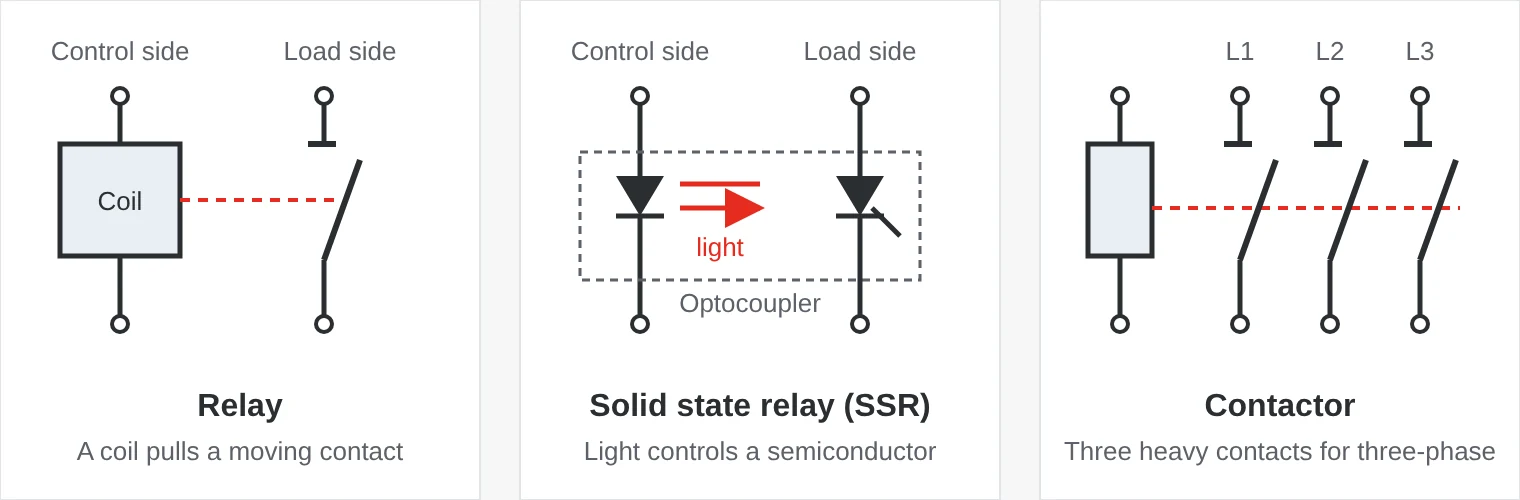
A relay has a coil that pulls a moving contact. The control side and the load side are electrically isolated. On DIN rail, interface relays let a PLC output drive a valve or lamp.
A solid state relay (SSR) has no moving parts. The control signal lights an LED in an optocoupler, and the light triggers a thyristor, triac or MOSFET that carries the load current. Switching is silent and wear-free. The price is heat and a small leakage current even when off.
A contactor is essentially a relay built for high power. It usually has three main contacts for three-phase, arc chutes and room for auxiliary contacts. AC contactors are tested to IEC 60947-4-1 with utilisation categories, such as AC-1 for resistive loads and AC-3 for starting and stopping induction motors.
| Property | Relay | Solid state relay (SSR) | Contactor |
|---|---|---|---|
| Typical current | Up to 10–16 A | A few A to about 100 A per phase | From about 10 A to over 1,000 A |
| Wear | Contacts wear | No mechanical wear | Contacts wear, but are more robust |
| Frequent switching | Less suitable | Very suitable | Less suitable |
| Heat | Low | About 1–1.5 W per amp | Low |
| Typical failure | Contacts weld together | Semiconductor fails in the on state | Contacts weld together |
Heat, heatsinks and zero crossing – what you need to know about SSRs
A thyristor-based SSR has a voltage drop of roughly 1–1.5 V. As a rule of thumb that gives 1–1.5 W of heat per amp, so an SSR carrying 25 A gives off 25–40 W. A heatsink’s capacity is given as thermal resistance in K/W – the lower, the better. In a worked example from Celduc, one of their SSRs carrying 40 A at 30 °C ambient needs a 1.2 K/W heatsink.
An SSR with zero-cross switching turns on only when the AC voltage passes zero. That reduces electrical noise and suits resistive loads such as heating elements. An SSR with random turn-on switches immediately and suits inductive loads such as transformers, where switching at the zero crossing can cause high inrush currents.
Example: a temperature controller pulses an SSR every second to keep a sealing jaw hot. That is over 80,000 operations a day – too many for a mechanical relay.
AC or DC: why direct current is harder to break
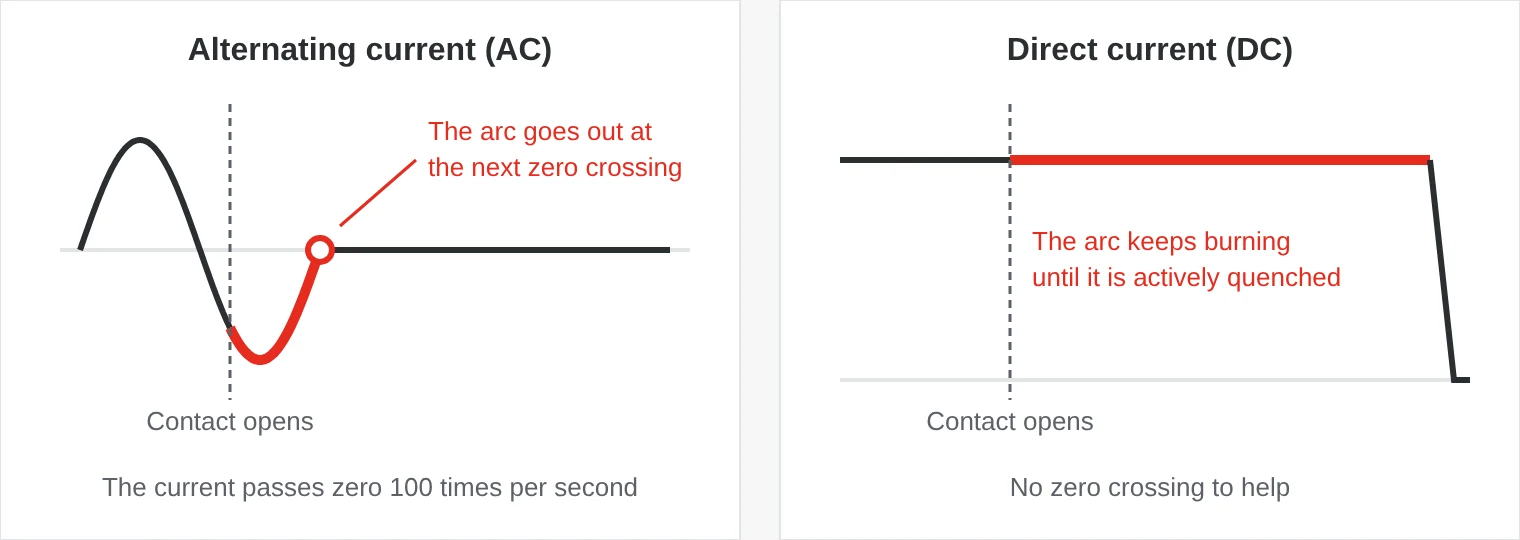
When contacts open under load, an arc forms. With alternating current the current passes zero 100 times per second at 50 Hz, and the arc goes out at the next zero crossing. Direct current has no zero crossing. The arc can keep burning and destroy the contacts. That is why a relay rated 250 V AC often handles only 30 V DC at the same current.
Battery systems, electric vehicles and solar installations therefore use high-voltage DC contactors for 400–1,500 V. The contacts sit in a hermetically sealed, gas-filled ceramic chamber, and magnets blow out the arc. Some models break full current in one direction only. A battery that is both charged and discharged needs a bi-directional contactor. Solid-state DC contactors break without any arc.
Timing relays, monitoring relays and safety relays
- Timing relay – delays switch-on or switch-off, flashes or controls star-delta motor starting. Example: run-on time for a fan.
- Monitoring relay – watches voltage, current, frequency, phase sequence or cos φ and trips when a value goes outside its limit. Example: a frequency monitor on a backup generator.
- Safety relay – monitors emergency stops, guard doors and light curtains. It has force-guided contacts and two channels, and is chosen for the performance level (PL to EN ISO 13849-1) the risk assessment requires.
Which should you choose? Application examples
| If you need to … | Choose |
|---|---|
| Boost a PLC output to drive a valve or lamp | Interface relay or I/O relay on DIN rail |
| Control heating with many operations per minute | Zero-cross SSR with heatsink |
| Start and stop a three-phase motor | Contactor rated for AC-3 plus motor protection |
| Connect and disconnect a 400–1,500 V DC battery | High-voltage DC contactor |
- Factories – interface relays for solenoid valves, SSRs for sealing jaws in packaging machines, contactors for conveyors.
- Vehicles and mobile machinery – main contactors in electric forklifts, e-buses and mining machines.
- Energy – battery storage and solar plants at 1,000–1,500 V DC, frequency monitors on generators.
- Infrastructure – pumping stations with pump alternator relays and timing relays in ventilation.
- Aerospace and defence – hermetically sealed relays for −70 to +125 °C.
- Laboratory and medical – silent SSRs for heating in incubators and analysers.
Five common mistakes
- SSR without an adequate heatsink. The rated current only applies with the right cooling. Use the temperature inside the cabinet.
- AC-rated relay on DC. A 10 A 250 V AC rating says nothing about DC. Check the DC data in the datasheet.
- Wrong utilisation category. A contactor handles more current for resistive loads (AC-1) than for motors (AC-3). Size it for the load.
- Forgetting the leakage current. An SSR that is off leaks a few milliamps – enough to make an LED lamp glow or a PLC input read a one.
- No protection circuit. Inductive loads cause voltage spikes when switched off, and lamps and capacitors cause high inrush currents. Use a flyback diode, RC snubber or varistor.
Relays and contactors from SCN
We carry interface relays from Mibbo and Tele Haase, solid state relays from Celduc, Mibbo and Nominal Controls, SSR heatsinks and accessories from Celduc and high-voltage DC contactors from Gigavac and Rincon Power. Timing and monitoring relays come from Tele Haase, and hermetically sealed relays for aerospace from Leach.
Examples from our range
 CelducSOBR965560-TH Dual Power Solid State Relay 2x24ANew: two-phase zero-cross solid state relay with push-in terminals, 2 × 24 A at 24–600 VAC – for heating loads.View product →
 GigavacGX16 chassis mount ContactorHermetically sealed chassis-mount contactor, IP67 and IP69K, for −55 to 85 °C.View product →
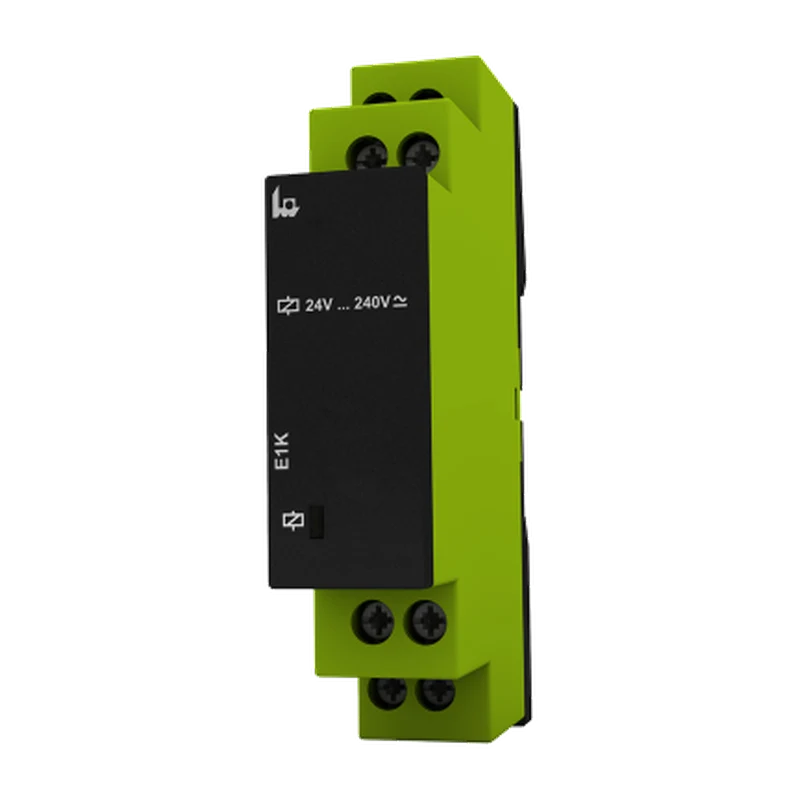 Tele HaaseE1K / E3K coupling relaysDIN rail coupling relays, 8 A at 250 V, that isolate PLC outputs from the load.View product →
Erik Ahlqvist is Managing Director of SCN and has spent more than 20 years helping industrial companies choose the right electronics for demanding environments. He holds a BSc in Electronics from KTH Royal Institute of Technology, Stockholm.
LinkedIn profileFrequently asked questions
What is the difference between a relay and a contactor?
Both use a coil to pull mechanical contacts. A contactor is built for higher currents and often has three main contacts for three-phase. Relays are mainly used for control signals and smaller loads.
Can a solid state relay replace a contactor?
Often, if the load is switched frequently and you can remove the heat. For motors and where you want an air gap in the off state, a contactor is usually better.
Why does my solid state relay get hot?
Its voltage drop of roughly 1–1.5 V gives 1–1.5 W of heat per amp. Without a heatsink it overheats at a few amps.
Can I use an AC relay for DC?
Only within the DC ratings in the datasheet, which are often much lower, since a DC arc is harder to put out.
What is an interface relay?
A relay between the control system and the load. It isolates the PLC output and lets a weak output switch a higher current or a different voltage.
Not sure whether your load needs a relay, an SSR or a contactor? Ask us – you get an answer within 24 hours.
Ask us