




Industrial power supplies – DIN rail, DC/DC and UPS
A power supply that is too small or too hot can stop an entire machine. Here is how to size, cool and protect the 24 V supply – and when you need redundancy, a UPS or a DC/DC converter.
 By Erik Ahlqvist, Managing Director of SCN · Updated 24 October 2026 · 8 min read
- Size with margin – add up the loads, allow for inrush currents and add roughly 20–30 %.
- Heat determines service life – above a certain temperature the output must be derated.
- Redundancy – two power supplies via a redundancy module survive the failure of one. Paralleling for more power gives no reserve.
- Fuses must trip – without current reserve, a circuit breaker often fails to trip on a short circuit.
- UPS and buffer modules – bridge outages, from seconds with capacitors to hours with batteries.
How does a switched-mode power supply work?
Almost every power supply in a control cabinet today is a switched-mode type. The mains voltage is rectified and then chopped at high frequency, which allows a small transformer. The voltage is then rectified and filtered again, and a regulator keeps the output stable.
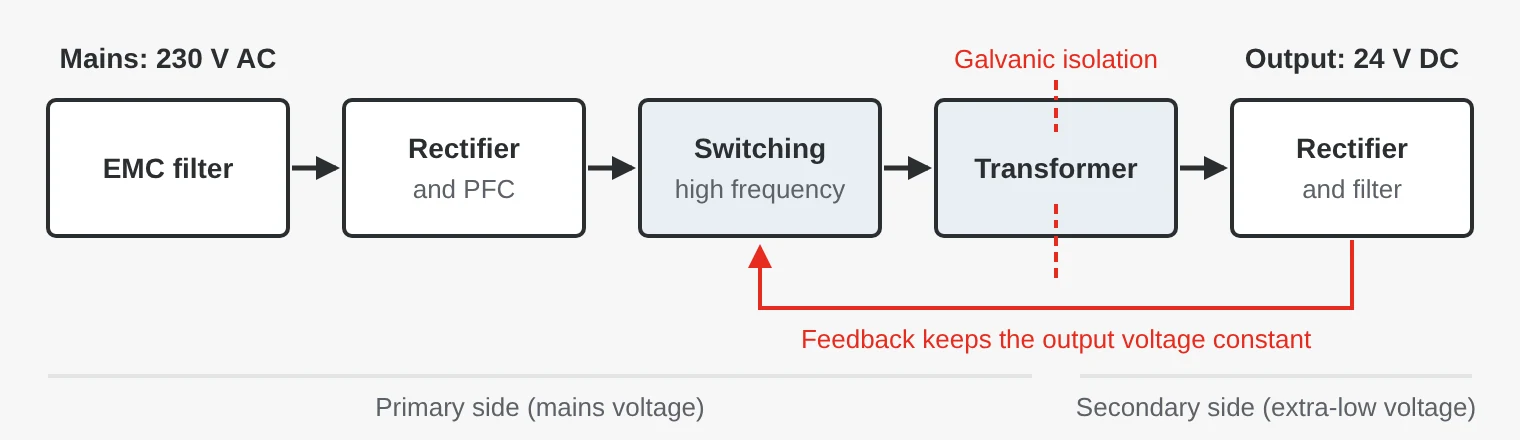
The transformer isolates the output galvanically from the mains, so the 24 V side can be treated as extra-low voltage (SELV or PELV). Equipment on the public grid must meet the harmonic limits in EN 61000-3-2, which apply from 75 W. That is why larger units have power factor correction (PFC).
What size of power supply do you need?
Add up the current of every load on 24 V: PLC, I/O, sensors, valves, relays and panels. Add about 20–30 % margin for expansion and cooler running.
Inrush currents and power reserve
Loads with large input capacitors, such as industrial computers, draw a heavy current pulse at switch-on. DC motors, solenoid valves and brakes draw several times their rated current at start.
Look for two things in the datasheet. Power reserve (boost) means the unit can deliver, for example, 150 % of rated power for a few seconds. Overload behaviour decides the rest: constant current limiting feeds full current until the load has started, while a unit that shuts down and retries (hiccup mode) may never start a large capacitive load.
Example: 12 A continuous load plus 25 % margin gives 15 A. A 24 V, 480 W unit (20 A) is enough, while 240 W (10 A) is too small.
Single-phase or three-phase, and which input range?
Below a few hundred watts, single-phase usually suffices. A wide input range such as 85–264 V AC works worldwide, and many units also accept DC.
At higher power, three-phase is common. It loads the phases evenly, and 340–550 V AC input covers both 400 V and 480 V networks.
24 V DC is the standard in automation, while 48 V is used in telecoms and for PoE. In small enclosures, width is counted in 17.5 mm modules, and ultra-slim units from one module wide fit distribution boards and building automation.
Efficiency, heat and mounting
At 480 W output and 94 % efficiency, losses are about 31 W. At 88 % they are 65 W – twice as much heat in the cabinet.
Above a certain ambient temperature, often 50–60 °C, output must be reduced along the derating curve. The rule of thumb is that electrolytic capacitor life halves for every 10 °C rise.
DIN rail power supplies are usually convection-cooled. Mount them in the orientation the datasheet specifies, with free space above and below. Mounting on the side or next to a frequency inverter may call for heavy derating.
Redundancy and selectivity – when the supply must not fail
In process plants, water treatment and tunnels, one failed unit must not cut the supply. The answer is N+1 redundancy: two units that can each carry the full load, connected through a redundancy module. The module decouples the outputs with diodes or MOSFETs (OR-ing), so a failed unit cannot pull down the healthy one. Wire up both DC OK contacts, or nobody will notice when one fails.
Paralleling with current sharing gives more power, but no reserve if the load needs every unit.
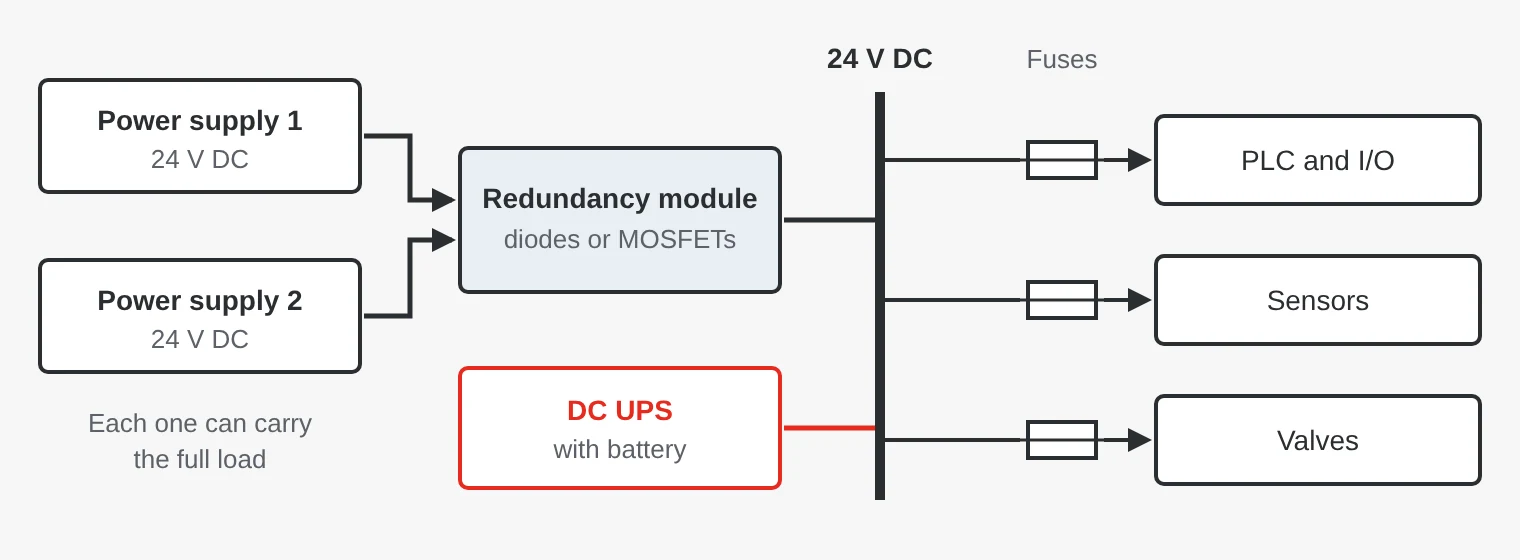
Selectivity means that only the fuse for the faulty circuit trips. A type B circuit breaker needs 3–5 times its rated current to trip instantly, type C 5–10 times. A 10 A power supply will therefore never trip a B6 breaker quickly, and the voltage drops for every load in the meantime. Use a unit that delivers a short current pulse of several times its rating, or electronic circuit breakers per output.
UPS and buffer modules for 24 V DC
A standard power supply holds its output for roughly 20 ms after an outage. Longer outages need something more:
- Capacitor buffer module – maintenance-free, for outages of up to a few seconds.
- DC UPS with battery – a controller charges the battery and switches it in on an outage. Lasts minutes or hours, so a PLC or computer can shut down in a controlled way.
- AC UPS (uninterruptible power supply) – for computers and equipment that need 230 or 115 V AC.
Lead-acid batteries age quickly in warm cabinets. Choose a controller with battery test and an alarm contact, and replace the battery regularly.
DC/DC converters for vehicles, rail and defence
A DC/DC converter turns a varying battery voltage into a stable one, for example 24 V to 12 V for a radio.
- Vehicles and mobile machines – the voltage dips during cranking and rises sharply on load dump, as described in ISO 16750-2. Choose a wide input range, such as 9–36 V.
- Isolated or non-isolated – an isolated converter breaks ground loops. A non-isolated one is smaller but shares the negative with the battery.
- Rail – EN 50155 sets requirements for temperature, voltage variation, interruptions, vibration and EMC at 24, 72 or 110 V DC.
- Defence and aerospace – MIL converters for 28 V, designed for the transients in MIL-STD-1275 (ground vehicles) and MIL-STD-704 (aircraft), often baseplate-cooled.
Which approvals do you need?
| Standard | Covers | Typical use |
|---|---|---|
| EN 62368-1 | Electrical safety for IT and AV equipment, has replaced EN 60950-1 | Automation, IT and telecoms |
| UL 508 or UL 61010-2-201 | Electrical safety for industrial control equipment in North America | Export to the US and Canada |
| IEC 60601-1 | Medical electrical equipment: isolation and leakage current, e.g. 2 × MOPP | Medical devices |
| EN 50155 | Electronics on rolling stock | Rolling stock |
| EN 61000-6-2 and -6-4 | EMC: immunity and emission in industrial environments | Equipment in control cabinets |
| MIL-STD-461, -704 and -1275 | EMC and power quality for defence equipment | Military vehicles, aircraft and ships |
Application examples and common mistakes
- Factory – 24 V for PLCs, I/O, sensors and valves.
- Vehicles and mobile machines – DC/DC converters for 12 and 24 V in forestry machines, forklifts, buses and emergency vehicles.
- Energy and infrastructure – DC-input units in substations, DC UPS in pumping stations and tunnels.
- Medical technology – power supplies to IEC 60601-1.
- Defence – MIL converters and UPS units for vehicles and ships.
- Sized for continuous load only. Inrush currents can cause overload at every switch-on.
- Derating forgotten. A power supply in a 60 °C cabinet can deliver only part of its rated power.
- Parallel mistaken for redundant. Without a redundancy module and reserve, one fault takes down everything.
- The fuse does not trip. Check that the unit can deliver enough current to trip the fuse.
Power supplies from SCN
We supply single-phase and three-phase DIN rail power supplies from Mean Well and Mibbo, and DC UPS controllers from Mean Well. For defence, aerospace and naval use we offer DC/DC converters, hold-up modules, AC/DC power supplies and UPS units from Enercon.
Examples from our range
 Mean WellSDR-480P Single Output Industrial DIN RAIL with PFC and Parallel Function 480W480 W with active PFC, 94 % efficiency, 150 % peak load, DC OK contact and current sharing for parallel use.View product →
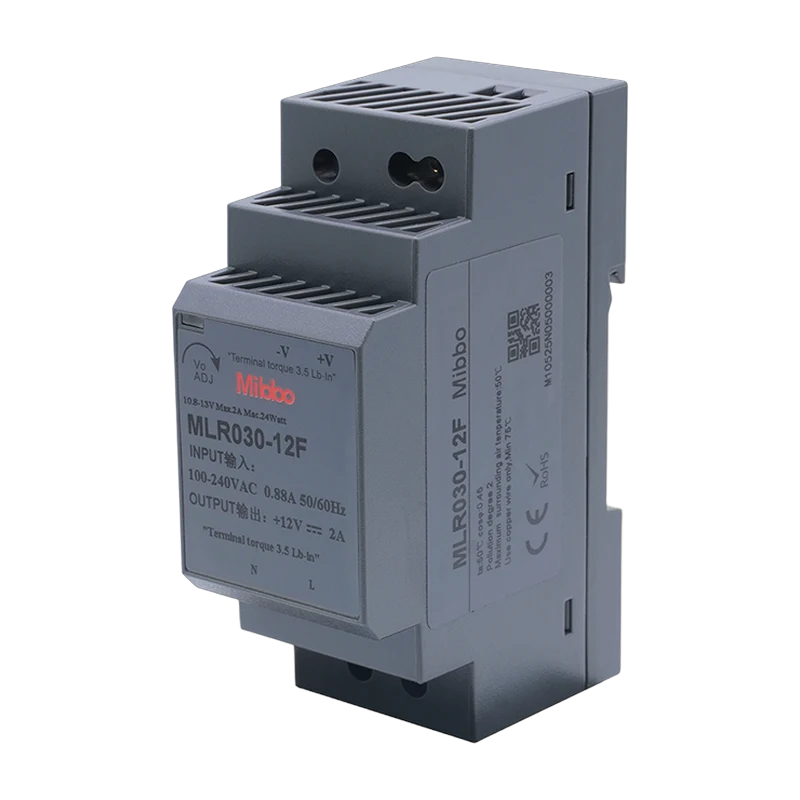 MibboMLR Ultra-Slim DIN Rail Power SupplyFrom 17.5 mm wide, 15–150 W, 85–264 V AC or 120–370 V DC input – for small cabinets.View product →
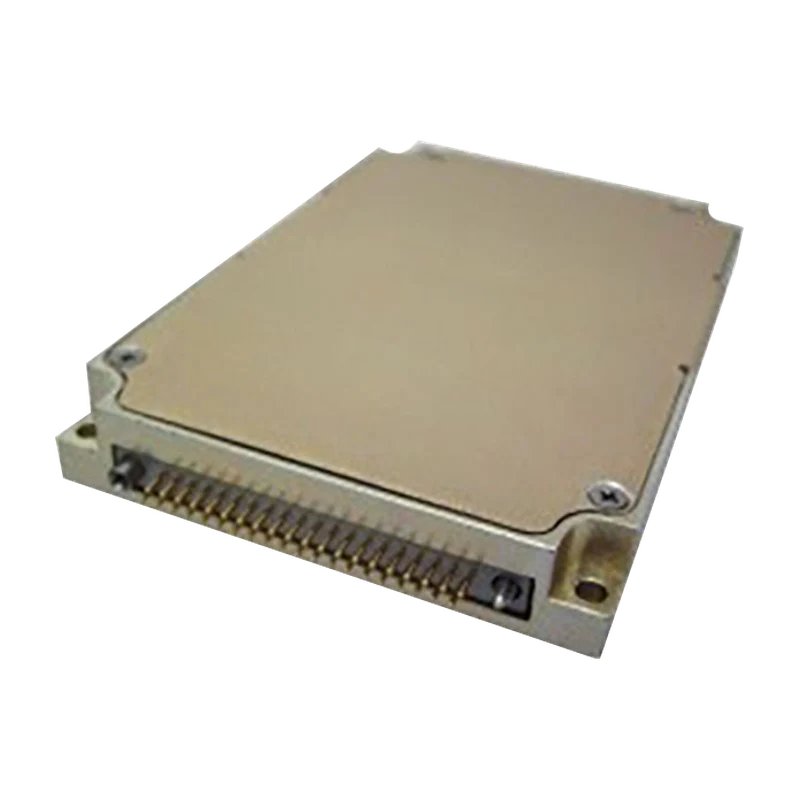 EnerconM8727 80 W dual-output DC-DC converterFor 28 V systems in ground vehicles and aircraft: 18–48 V DC input, −55 to +85 °C, designed to meet MIL-STD-1275 and MIL-STD-704.View product →
Erik Ahlqvist is Managing Director of SCN and has spent more than 20 years helping industrial companies choose the right electronics for demanding environments. He holds a BSc in Electronics from KTH Royal Institute of Technology, Stockholm.
LinkedIn profileFrequently asked questions
What size of power supply do I need?
Add up the current of all loads, allow for inrush currents and add 20–30 % margin. Check that the rating applies at the cabinet temperature.
What is the difference between a linear and a switched-mode power supply?
A linear supply turns surplus voltage into heat. It is electrically quiet but inefficient. A switched-mode supply is smaller and far more efficient.
Can you connect two power supplies in parallel?
Yes, if they are designed for it and have current sharing. For redundancy you also need a redundancy module, and each unit must be able to carry the full load on its own.
What is the difference between a DC UPS and a buffer module?
A buffer module stores energy in capacitors and covers outages of up to a few seconds without maintenance. A DC UPS uses a battery and lasts minutes or hours, but the battery must be checked and replaced.
Not sure what size of power supply you need, or how to build a redundant 24 V supply? Ask us – you get an answer within 24 hours.
Ask us