




Inductive proximity sensors – how they work and how to choose
An inductive proximity sensor detects metal without contact and does not wear out from switching. This guide explains how it works, what the sensing distance means in practice and how to choose mounting, output and robustness.
 By Erik Ahlqvist, Managing Director of SCN · Updated 24 October 2026 · 7 min read
- Detects metal only – from under a millimetre to a few centimetres, without contact or wear.
- Design for the assured distance – at most 81% of the rated distance Sn, and shorter for stainless steel, brass, aluminium and copper.
- Flush or non-flush – flush can sit level with metal, non-flush reaches further but needs free space.
- PNP and NO are most common in Europe. Check what the PLC input expects.
- Harsh conditions – stainless housing and IP69K for high-pressure washdown, a weld-field immune sensor near spot welding.
What is an inductive sensor and how does it work?
An inductive sensor, or inductive proximity switch, is an electronic switch that changes state when metal comes close. It is used wherever a machine needs to know whether something is in place: a tool, a gear tooth, a pallet or a closed hatch.
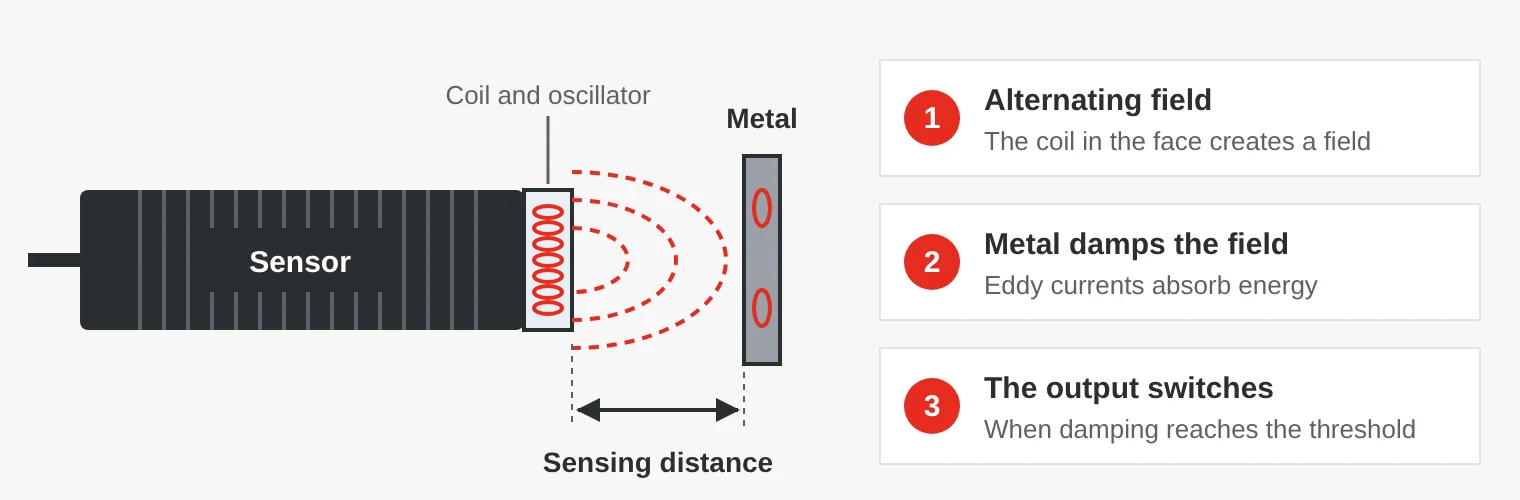
Behind the face is a coil which, together with an oscillator, creates an alternating magnetic field. When metal enters the field, eddy currents draw energy from the oscillator. When the damping is large enough, the output switches. The sensor has no moving parts and is not affected by dust, oil and dirt the way an optical sensor is.
Sensing distance and mounting
The distance in the datasheet is the rated sensing distance, Sn. It is measured against a standard target of mild steel, 1 mm thick, as defined in IEC 60947-5-2. In practice it varies with temperature, voltage and from unit to unit.
That is why there is an assured sensing distance, Sa, which is at most 81% of Sn. Within Sa the sensor is guaranteed to switch, so design for Sa. An M18 sensor with an Sn of 8 mm should have the object within about 6.5 mm. An object smaller than the standard target also gives a shorter distance.
Correction factor – different metals, different distances
Metals other than steel are detected at shorter distances. Multiply Sn by the correction factor for the metal. Values are typical; check the datasheet. There are also factor 1 sensors, which detect all metals at the same distance.
| Metal | Typical factor | M18 with Sn 8 mm reaches about |
|---|---|---|
| Mild steel | 1.0 | 8 mm |
| Stainless steel | 0.7–0.85 | 5.5–7 mm |
| Brass | 0.4–0.5 | 3–4 mm |
| Aluminium | 0.3–0.45 | 2.5–3.5 mm |
| Copper | 0.25–0.4 | 2–3 mm |
Flush or non-flush?
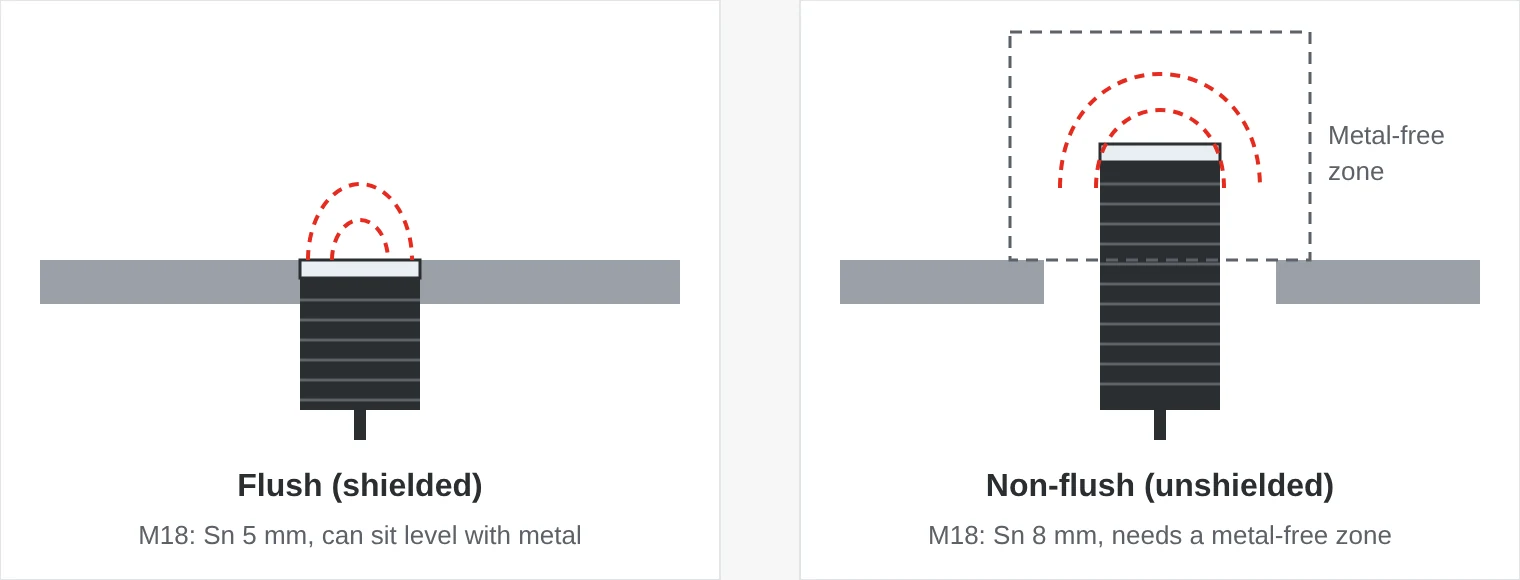
A flush (shielded) sensor has a shield around the coil, so the field points straight ahead. It can be mounted level with metal. A non-flush (unshielded) sensor has a wider field and roughly 1.5–2 times the distance in the same size. In return the head needs a metal-free zone around it, or the sensor will detect its own bracket. Sensors mounted close together can interfere – keep the spacing in the datasheet.
Output and connection: PNP, NPN, NO, NC and IO-Link
- PNP switches the positive supply to the load. Standard for most PLC inputs in Europe.
- NPN switches the load to 0 V. Common on Asian and older machines.
- NO (normally open) is active when metal is present, NC (normally closed) when no metal is present.
| Type | Wires | Use it when |
|---|---|---|
| 2-wire | Supply and signal on the same two wires, DC or AC | The sensor replaces a limit switch or sits in series with a relay. Needs a minimum load current and has a small leakage current. |
| 3-wire | Positive, 0 V and output | The standard choice for PLC inputs. |
| 4-wire | Positive, 0 V and two outputs | You want both NO and NC, or a switching output plus IO-Link. |
| IO-Link | Three wires, unshielded cable up to 20 m | You want to set up the sensor from the PLC, read diagnostics and swap sensors without readjusting (IEC 61131-9). |
The connector is usually M8 on small sensors and M12 on the rest. Wire colours are standardised: brown positive, blue 0 V, black output and white second output. A connector makes replacement much quicker than a fixed cable.
Inductive, capacitive or Hall effect sensor?
| Sensor type | Detects | Good for |
|---|---|---|
| Inductive | Metal, at short range | Positions, end positions, gear teeth and metal parts |
| Capacitive | Almost anything: metal, plastic, wood, liquids and granules | Level in tanks and silos, even through a plastic or glass wall. Affected by moisture and build-up. |
| Hall effect | Magnetic fields: a magnet or teeth of iron and steel | Speed and direction, even at very low speeds, and position through an aluminium or stainless wall |
Rule of thumb: if the object is metal and the distance is short, choose inductive. If it is anything else, choose capacitive. For speed and direction from a gear wheel in harsh conditions, choose a Hall effect sensor.
Where are inductive sensors used?
- Factory and packaging – tool and slide positions, counting metal caps, checking that a part is in the fixture.
- Mobile machines – boom and outrigger positions, wheel and axle speed on cranes, agricultural and forestry machines.
- Food and pharma – conveyors and filling machines that are washed down every day.
- Automotive production – checking that sheet metal parts are in place before the robot welds.
- Infrastructure and transport – limit positions on lock gates, bridges and rail switches, door positions on trains and buses.
- Energy – position feedback from dampers and valves in power and heating plants.
Robustness and common mistakes
IP67 is enough for most machines. High-pressure washdown with hot water needs IP69K, preferably with a stainless housing and face. Near spot welding, strong magnetic fields can cause false switching, and spatter sticks to the face. Choose weld-field immune sensors with a coating that spatter does not stick to.
- Designing for Sn. Use at most 81% of Sn, and apply the correction factor if the object is not steel.
- A non-flush sensor in a metal bracket. The sensor detects its own bracket and stays on.
- The wrong output type. An NPN sensor on a PNP input will not work. Check NO or NC too.
- 2-wire sensors on sensitive inputs. The leakage current can be enough for an electronic input to read the signal as high.
- Using the sensor as a mechanical stop. The object should pass in front of the sensor, not hit it. Let an end stop take the force.
Inductive sensors from SCN
We carry inductive sensors from Mibbo and Wenglor: threaded miniature sensors from M4, long-range sensors up to M30, DC or AC supply, analogue output and stainless housings with IP69K. We also carry capacitive and Hall effect sensors.
Examples from our range
 WenglorI12H019 Inductive SensorInductive sensor with IO-Link: three switching distances, PNP or NPN and NO or NC set in one sensor. IP67.View product →
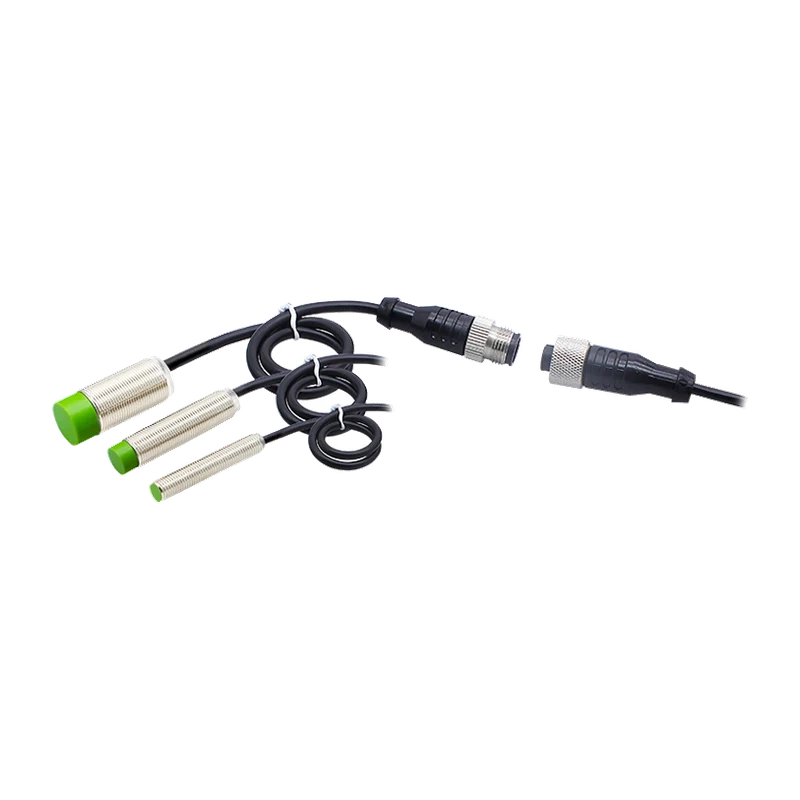 MibboIYK Anti-Interference Inductive SensorAnti-interference sensor for side-by-side mounting and electromagnetically noisy machines. NPN or PNP, NO or NC.View product →
 Rheintacho2-Channel Differential-Hall M18Hall effect sensor in a stainless M18 housing that measures speed and direction, 0.1–20 kHz.View product →
Erik Ahlqvist is Managing Director of SCN and has spent more than 20 years helping industrial companies choose the right electronics for demanding environments. He holds a BSc in Electronics from KTH Royal Institute of Technology, Stockholm.
LinkedIn profileFrequently asked questions
What is the difference between PNP and NPN?
A PNP sensor switches the positive supply to the load, an NPN sensor switches the load to 0 V. The sensor must match the input of your control system.
Can an inductive sensor detect aluminium?
Yes, but at a shorter distance. With a correction factor of around 0.3–0.45, the distance is roughly a third of the rated value. Choose a factor 1 sensor if the distance is critical.
How far can an inductive sensor detect?
From under a millimetre for the smallest sensors to around 40 mm for long-range M30 sensors. A larger diameter and non-flush mounting give a longer distance.
Can an inductive sensor detect through a wall?
Through a thin plastic wall, yes. Through metal, no – it will detect the wall. In that case a Hall effect sensor with a magnet on the object is used instead.
Not sure about distance, output or robustness? Describe the object and the environment, and we will help you choose the right sensor – you get an answer within 24 hours.
Ask us