




Absolute vs incremental encoder – how to choose
A rotary encoder tells you how a shaft turns: how fast, in which direction and in what position. This guide explains the difference between incremental and absolute encoders, singleturn and multiturn, interfaces and mechanics.
 By Erik Ahlqvist, Managing Director of SCN · Updated 24 October 2026 · 7 min read
- Incremental encoder – gives pulses as the shaft turns. Simple and affordable for speed and relative position, but loses its position when power is lost.
- Absolute encoder – gives a unique code for every position. Knows where the shaft is at start-up, without homing.
- Singleturn or multiturn – singleturn tracks position within one revolution, multiturn also counts revolutions.
- The interface drives the choice – HTL or TTL for pulses, SSI or BiSS for fast position data, CANopen, PROFINET or EtherCAT for networks.
- Magnetic or optical – magnetic copes best with shock, moisture and dirt, optical gives the highest resolution.
What is an encoder?
A rotary encoder sits on a motor shaft, a wheel or a roller and turns the movement into electrical signals. The control system uses them to regulate speed, measure length or position an axis.
There are two main types. An incremental encoder tells you that the shaft has moved and by how much. An absolute encoder tells you where the shaft is. The difference is most obvious when the power goes off.
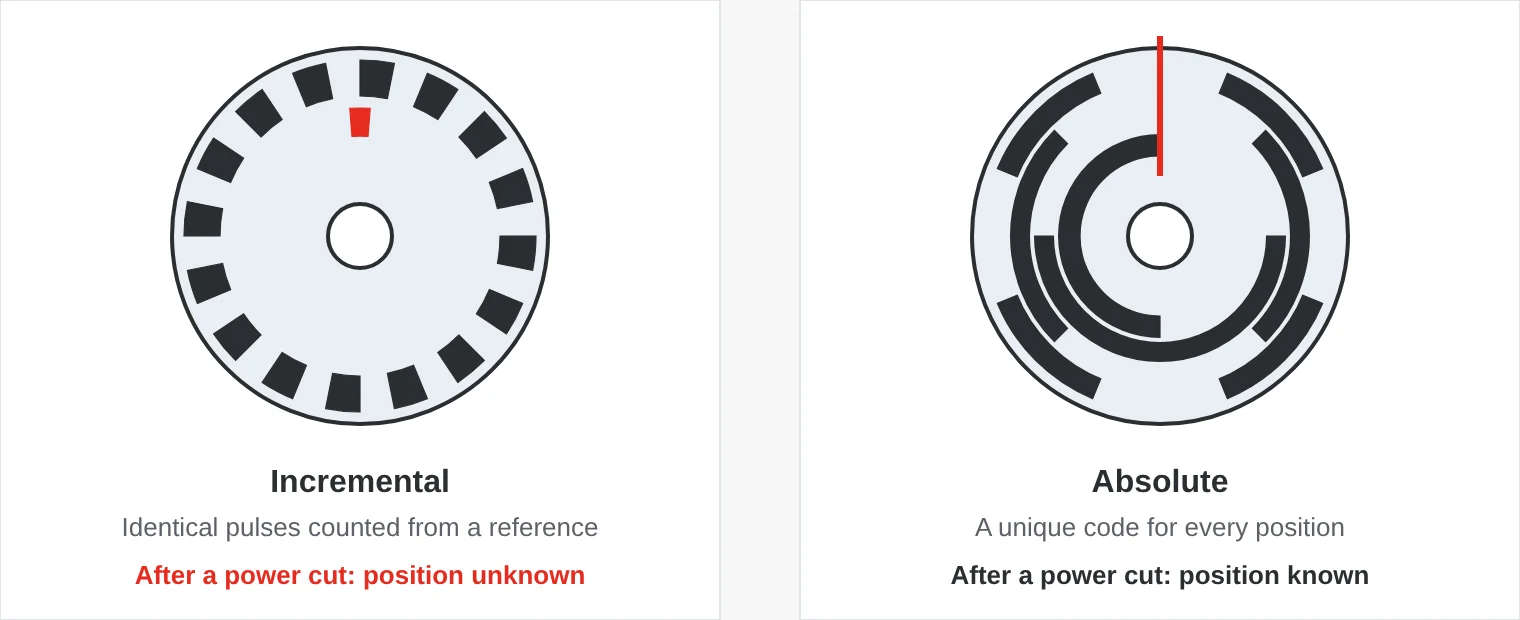
Incremental or absolute – how they work
Incremental encoder
An incremental encoder gives a set number of pulses per revolution, for example 1,024. The control system counts the pulses from a reference point. Channels A and B are shifted by a quarter period, 90°, from each other. From the order of the channels, the controller can tell the direction of rotation, and by counting every edge it gets four times the resolution: 1,024 pulses become 4,096 steps per revolution. Channel Z, the index pulse, comes once per revolution and serves as a reference.
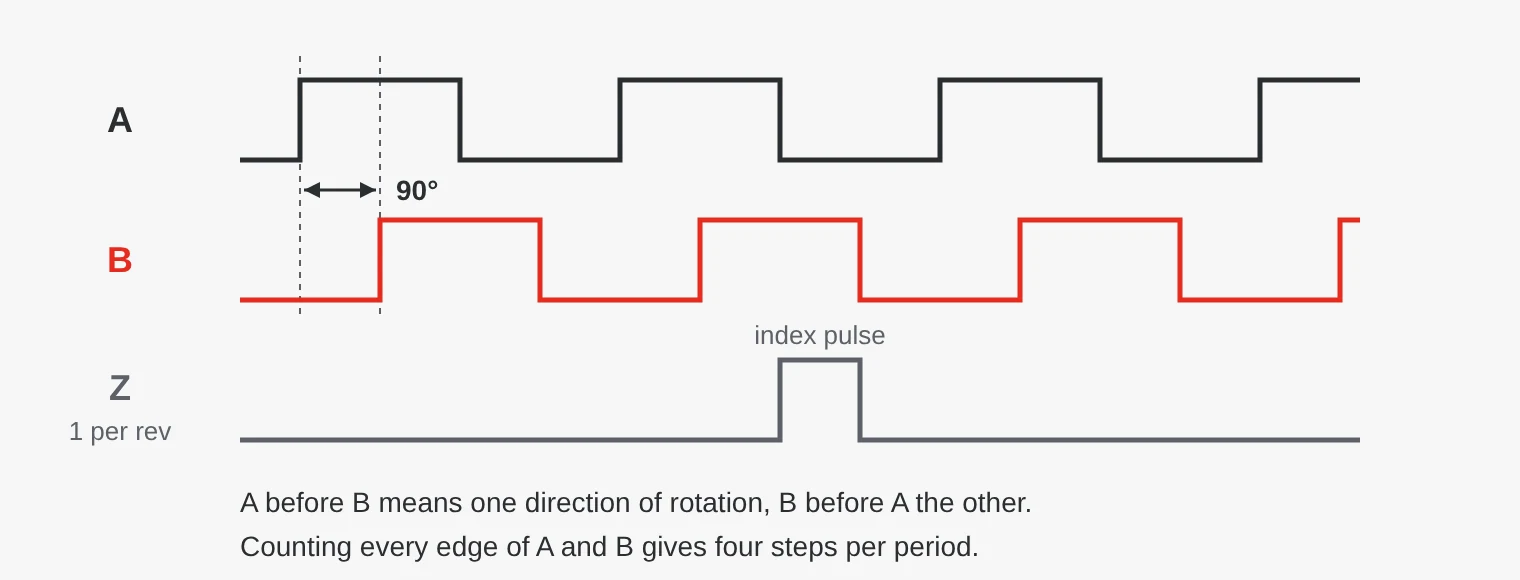
The drawback is that the count is lost when power is interrupted, and interference can add or drop pulses. The machine must then move to a reference position before it knows where it is.
Absolute encoder
An absolute encoder reads a unique code for every angular position. Resolution is given in bits: 12 bits give 4,096 positions per revolution, 16 bits give 65,536. The position is available immediately at start-up, even if the shaft was turned while the power was off.
A singleturn encoder starts over every revolution and is enough when the movement is one turn or less, such as a valve or a rotary table. A multiturn encoder also counts revolutions, often 4,096 or more. You need it when a spindle, winch drum or rack makes many turns. Revolutions are counted with gears, with a battery or with a so-called Wiegand wire, which takes its energy from the movement itself and needs no battery.
Interfaces: HTL, TTL, SSI, BiSS and fieldbuses
| Interface | Type | Good for |
|---|---|---|
| HTL (push-pull) | Incremental pulses, 10–30 V | PLC inputs and counter cards in 24 V systems, good noise immunity |
| TTL (RS422) | Incremental pulses, 5 V differential | Frequency inverters and servo drives, high frequencies |
| SSI | Absolute, serial point-to-point | Fast position data to a PLC or drive |
| BiSS C | Absolute, serial, open and bidirectional | Servo motors and precision axes that need speed and diagnostics |
| CANopen, SAE J1939 | Fieldbus | Mobile machines with several sensors on one cable |
| PROFINET, EtherCAT, EtherNet/IP | Industrial Ethernet | Factories where the encoder connects straight into the PLC network |
| IO-Link | Point-to-point via M12 | Simple positioning tasks with set-up from the PLC |
Many modern encoders are programmable, so pulse count, output type and counting direction can be set with a tool. That means fewer variants in your spare parts store.
Shaft or hollow shaft, optical or magnetic
A solid shaft encoder is connected to the machine shaft with a flexible coupling that takes up misalignment. A hollow shaft encoder slides straight onto the motor shaft and is held by a torque arm. A hollow shaft saves space and a coupling, while a solid shaft encoder is easy to replace and protects its bearings from movement in the machine shaft.
Optical encoders read a code disc with light and give very high resolution and accuracy, but are sensitive to condensation, dirt and heavy shock. Magnetic encoders read a magnet with a Hall or magnetoresistive sensor. They cope better with vibration, moisture and dirt and are often the first choice for mobile machines and outdoor use.
Which one should I choose?
| If you need to … | choose |
|---|---|
| Measure speed or conveyor velocity | Incremental, HTL or TTL |
| Know the position right after a power cut | Absolute multiturn |
| Measure an angle within one revolution | Absolute singleturn |
| Provide feedback to a servo motor | Absolute with BiSS C or SSI |
| Fit an encoder on a mobile machine exposed to weather | Magnetic absolute encoder with CANopen or J1939 and IP67 or higher |
| Cover different pulse counts on different machines | Programmable incremental encoder |
- Incremental where the position must be kept. After a power cut the machine must home again, which is not always possible with a moving load. Choose absolute.
- The wrong signal level. A 5 V TTL encoder gives no reliable signal on a 24 V input, and an HTL encoder can damage a TTL input.
- A rigid coupling. Misalignment that a flexible coupling does not absorb wears out the encoder bearings.
- Long unshielded cable. Interference adds or drops pulses. Use shielded twisted-pair cable and differential signals.
- Singleturn for several turns. The encoder starts over every revolution and cannot tell the turns apart.
Where are encoders used?
- Factory and packaging – length measurement on conveyors, cutting, labelling and synchronising rollers.
- Cranes and lifting – hoist height on winches, slewing angle and position of overhead cranes.
- Mobile machines – steering angle, boom angle and position of attachments.
- Energy – blade pitch and yaw in wind turbines, position of solar trackers.
- Infrastructure – lock gates, movable bridges, stage machinery and gates.
- Medical technology – positioning of patient tables and X-ray equipment.
- Defence – rotation of antennas, masts and sensor platforms.
Encoders from SCN
We carry incremental and absolute encoders from Posital, with interfaces such as CANopen, EtherCAT and IO-Link, programmable incremental encoders with HTL or TTL output, and versions with IP68 and IP69K for mobile machines.
Examples from our range
 PositalUCD-EC00B-0016-HETS-PRM Absolute encoderAbsolute encoder with EtherCAT for factory automation, IP66/IP67 and −40 to +85 °C.View product →
 PositalUCD-CA01B-1216-D10D-PRV Absolute encoderAbsolute encoder with CANopen for mobile machines, IP68 and IP69K. Keeps its position even when power is lost.View product →
 PositalUCD-IPH00-XXXXX-0340-2RW Incremental rotary encoderProgrammable incremental encoder with 1–16,384 pulses per revolution and push-pull (HTL) or RS422 (TTL) output.View product →
Erik Ahlqvist is Managing Director of SCN and has spent more than 20 years helping industrial companies choose the right electronics for demanding environments. He holds a BSc in Electronics from KTH Royal Institute of Technology, Stockholm.
LinkedIn profileFrequently asked questions
What is the difference between an absolute and an incremental encoder?
An incremental encoder gives pulses counted from a reference and loses its position when power is lost. An absolute encoder gives a unique code for every position and knows where the shaft is at start-up.
What does PPR mean?
PPR stands for pulses per revolution. With quadrature (4x) decoding of A and B, 1,000 PPR gives 4,000 counts per revolution.
What is the difference between HTL and TTL?
HTL works at the supply voltage, usually 10–30 V, and suits PLC inputs. TTL to RS422 is a differential 5 V signal that suits drives and high frequencies.
Does an absolute encoder need a battery?
A singleturn encoder never needs a battery. Multiturn encoders count turns with gears, a battery or a Wiegand wire, and gear and Wiegand designs work without a battery.
What is SSI?
SSI (Synchronous Serial Interface) is a simple point-to-point interface where the controller sends clock pulses and the encoder replies with its position bit by bit. It is common on absolute encoders.
Not sure about type, resolution or interface? Tell us about the shaft and the control system, and we will help you choose – you get an answer within 24 hours.
Ask us