




Inclinometer sensors for mobile machines – static or dynamic?
An inclinometer measures the angle to vertical on cranes, aerial work platforms, excavators and solar trackers. This guide explains why a simple sensor can show the wrong angle when the machine moves, and how to choose axes, accuracy, interface and safety level.
 By Erik Ahlqvist, Managing Director of SCN · Updated 24 October 2026 · 7 min read
- Static inclinometer – measures gravity with an accelerometer. Accurate when the machine is still or moving slowly.
- Dynamic inclinometer – combines accelerometer and gyroscope through sensor fusion. Needed when the machine accelerates, brakes, slews or vibrates.
- One or two axes – one axis with 360° for booms, two axes with ±90° for levelling chassis and platforms.
- Accuracy is not resolution – a sensor can display 0.01° and still be accurate to only ±0.3°.
- CANopen and SAE J1939 are standard on mobile machines. Analogue 4–20 mA or 0–10 V suits simpler controls.
What does an inclinometer measure?
An inclinometer, or tilt sensor, measures the angle between the sensor and vertical. It needs no mechanical link to a shaft. You simply bolt it to the part whose angle you want: a boom, a chassis, a bucket or a row of solar panels.
Inside is a MEMS accelerometer, a tiny silicon structure that senses gravity. When the sensor tilts, gravity is shared between its axes, and the angle is calculated from the ratio between them.
Static or dynamic – why the sensor can be wrong
An accelerometer cannot tell gravity from any other acceleration. When the machine stands still, that is no problem. But when a crane boom slews, an excavator brakes or a tractor drives over a rock, the acceleration of the movement adds to gravity, and the sensor thinks the angle has changed.
The error grows quickly. A lateral acceleration of 0.1 g, about 1 m/s², gives an angle error of almost 6 degrees.
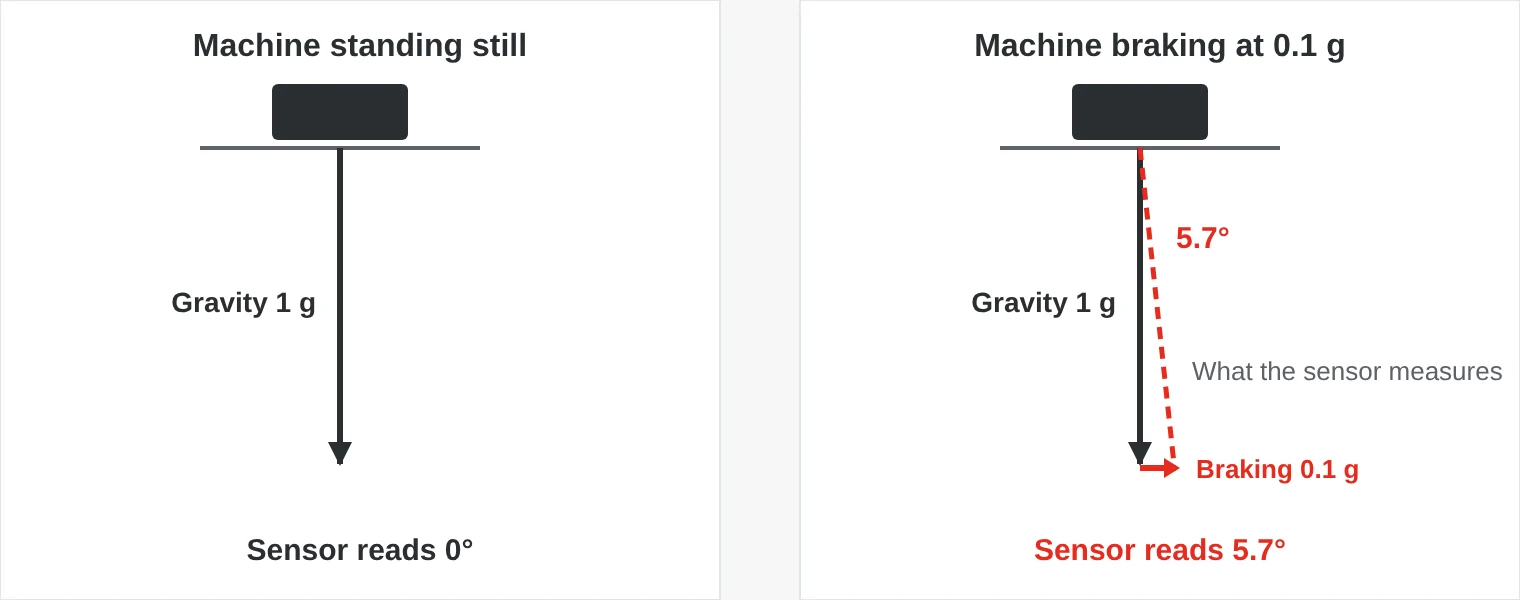
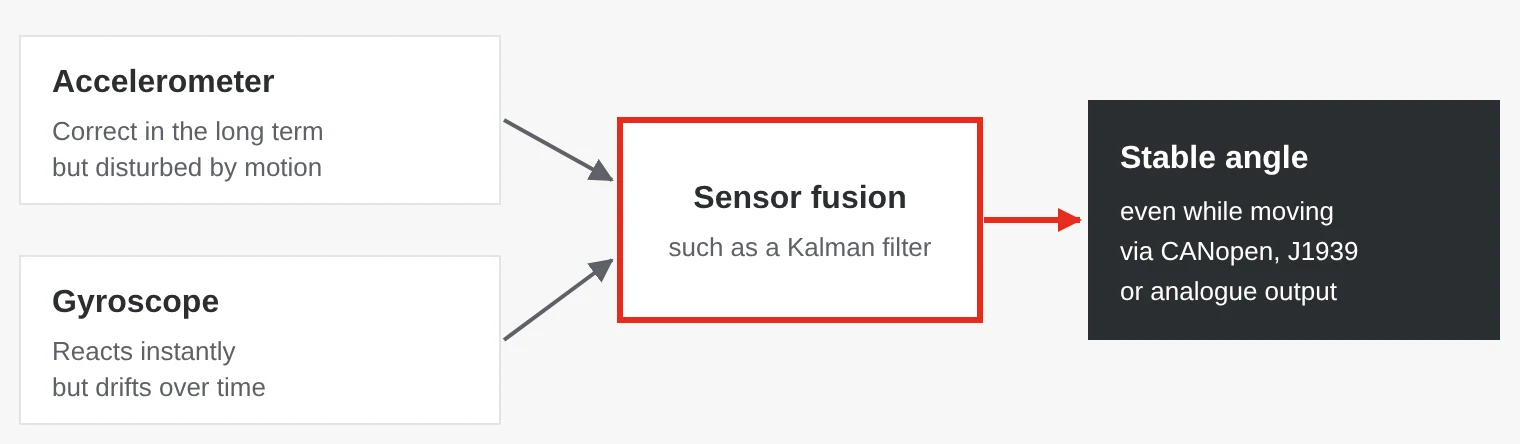
A static sensor damps the disturbances with filters, but that also makes the signal slow. A dynamic sensor has both an accelerometer and a gyroscope. The gyro measures rotation rate and reacts instantly to real changes in angle, but drifts slowly over time. The accelerometer is right in the long term but disturbed by motion. With sensor fusion, often a Kalman filter, the angle becomes both fast and stable.
| If you need to … | choose |
|---|---|
| Level outriggers or a chassis while the machine is still | Static, two axes |
| Measure a boom or arm angle during movement | Dynamic, one or two axes |
| Control a slowly rotating solar tracker | Static, one axis – dynamic if wind and vibration are significant |
| Measure tilt on a moving vehicle, for example off-road | Dynamic sensor or 6-axis IMU |
| Run your own motion and stability algorithms | IMU with raw accelerometer and gyro data |
Axes, accuracy and common mistakes
A single-axis sensor with a 360° range suits anything that rotates in one plane, such as a crane boom. A dual-axis sensor measures pitch and roll, usually ±90°, and suits levelling of chassis, platforms and implements.
Distinguish between resolution and accuracy. Resolution is the smallest step the sensor can show, for example 0.01°. Accuracy tells you how close the value is to the truth, for example ±0.1° or ±0.5°. Dynamic sensors are often given two values: static accuracy when the machine is still and dynamic accuracy when it moves. Also check temperature drift – mobile machines work in both winter cold and summer heat.
- A static sensor on a moving machine. The value jumps when the machine brakes or slews, and a heavy filter makes it sluggish. Choose a dynamic sensor.
- Mounting on a vibrating part. On a thin plate the sensor measures the movement of the plate. Mount it on a rigid surface.
- Confusing resolution with accuracy. Two decimals do not make a value correct. Compare accuracy and temperature drift.
- Wrong mounting orientation. The sensor measures relative to its housing. Check axis, direction and zero point during commissioning.
Outputs: CANopen, SAE J1939 or analogue
- CANopen – common on cranes, aerial platforms and other mobile machines. Inclinometers have their own device profile, CiA 410, which makes sensors from different makers similar to configure.
- SAE J1939 – standard in trucks, agricultural and construction machinery. A good fit when the sensor joins the same network as engine and transmission.
- Analogue 4–20 mA or 0–10 V – simple connection to a PLC or controller without CAN. 4–20 mA copes with long cables and shows a broken wire as 0 mA.
Sensors mounted on the outside of a machine must withstand weather, washing and vibration. IP67 and IP69K, M12 connectors and a temperature range down to −40 °C are common.
Functional safety: ISO 13849, IEC 61508 and ISO 25119
When the inclinometer is there to stop a crane or aerial platform from tipping over, it becomes part of a safety function. Requirements then apply to the whole chain from sensor to controller, and the sensor often needs to be certified.
- ISO 13849-1 – safety of machinery, with performance levels PL a–e.
- IEC 61508 – the basic functional safety standard, with SIL 1–4.
- ISO 25119 – tractors and machinery for agriculture and forestry, with AgPL a–e.
- ISO 19014 – earth-moving machinery such as excavators and wheel loaders.
Product standards often refer to these, for example EN 280-1 for aerial work platforms and EN 13000 for mobile cranes. If the sensor is part of a safety function, ask for the certificate and safety manual – high accuracy is not enough.
Where are inclinometers used?
- Cranes – boom angle for load moment limitation and chassis tilt before the outriggers are locked.
- Aerial work platforms – tilt monitoring that stops movement when the machine leans too far.
- Excavators – angle of boom, stick and bucket for machine control.
- Agriculture and forestry – levelling sprayer booms, harvester tilt and stability on slopes.
- Energy – solar trackers that turn the panels to follow the sun.
- Rail and infrastructure – track maintenance machines and monitoring of bridges and slopes.
- Medical technology – tilt of patient tables and beds.
- Defence and rescue – levelling of vehicles, masts and antennas.
Inclinometers from SCN
We carry static and dynamic inclinometers and 6-axis IMUs from Gemac and Posital, with CANopen, SAE J1939 and analogue outputs. There are economical versions for simpler machines and precision sensors with ±0.1° static accuracy.
Examples from our range
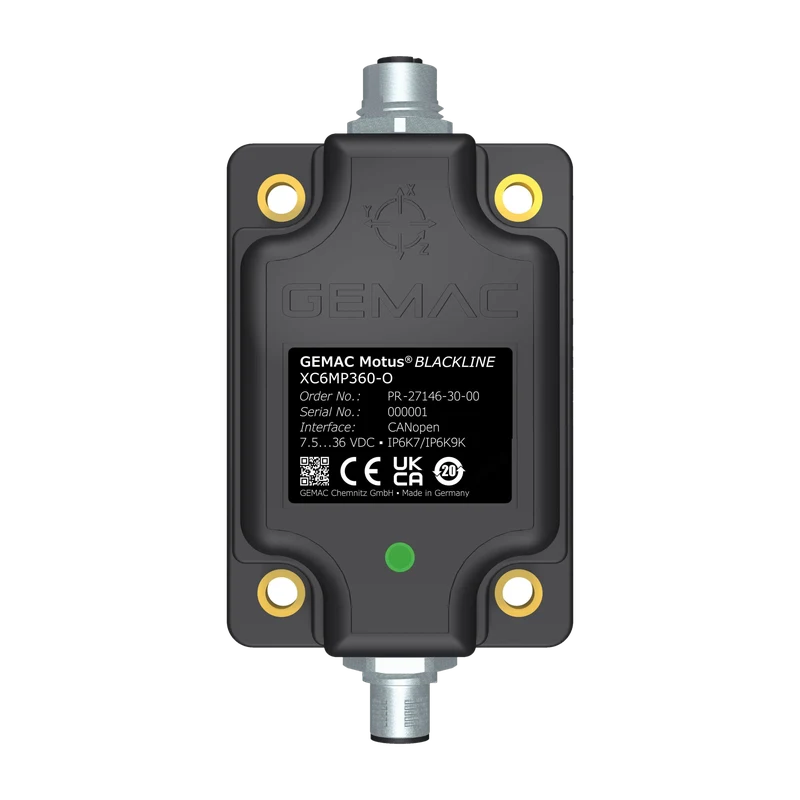 GemacMOTUS Blackline NC Dynamic InclinometerDynamic dual-axis sensor with ±0.1° static and ±0.5° dynamic accuracy. Kalman filter against vibration and acceleration.View product →
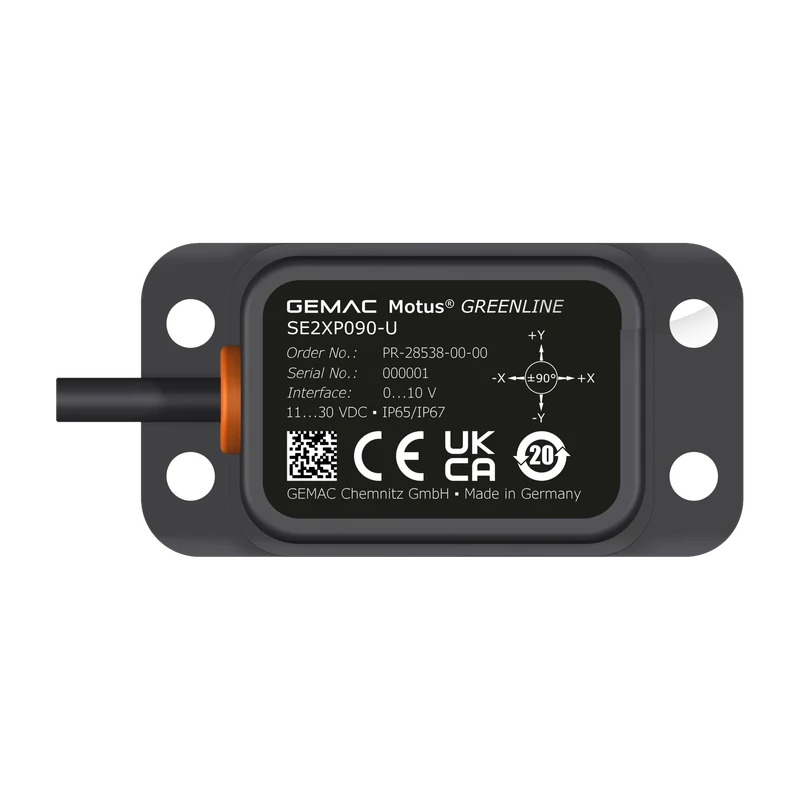 GemacMOTUS Greenline SE Static Tilt SensorEconomical static sensor, one axis 360° or two axes ±90°. CANopen, SAE J1939, 4–20 mA or 0–10 V.View product →
 PositalAKS-360-1-CA01-VK2-PW InclinometerInclinometer with CANopen, IP68 and IP69K, for −40 to +75 °C.View product →
Erik Ahlqvist is Managing Director of SCN and has spent more than 20 years helping industrial companies choose the right electronics for demanding environments. He holds a BSc in Electronics from KTH Royal Institute of Technology, Stockholm.
LinkedIn profileFrequently asked questions
Are an inclinometer and a tilt sensor the same thing?
Yes. Inclinometer, tilt sensor and inclination sensor are used for the same type of sensor, which measures the angle to vertical.
Why is my inclinometer wrong when the machine moves?
A static sensor cannot tell gravity from acceleration. When the machine brakes, slews or vibrates, the movement is read as tilt. A dynamic sensor with a gyroscope and sensor fusion solves this.
What is an IMU?
An IMU (inertial measurement unit) has a three-axis accelerometer and a three-axis gyroscope. It gives acceleration and rotation rate in all directions, and often a calculated tilt as well.
How accurate is an inclinometer?
Sensors for mobile machines are often accurate to ±0.1–0.5° when the machine is still. During movement the error grows, especially for static sensors.
Do I need a safety-rated inclinometer?
If the sensor is part of a safety function, such as tip-over protection on a crane or aerial platform, the function must meet the level required by the risk assessment. That often requires a certified sensor.
Tell us how the machine moves and which control system you use, and we will help you choose the right inclinometer – you get an answer within 24 hours.
Ask us