




Fiber media converter – how to choose the right one
A media converter connects copper cable to fiber, so Ethernet can reach beyond 100 metres and withstand electrical interference. This guide covers single-mode and multimode, SFP, reach and what sets an industrial converter apart from an office model.
 By Erik Ahlqvist, Managing Director of SCN · Updated 24 October 2026 · 7 min read
- Why fiber – copper reaches 100 metres. Fiber reaches kilometres, is not affected by electrical interference and breaks the galvanic connection.
- Multimode – for shorter runs within a site: up to about 2 km at 100 Mbit/s, a few hundred metres at gigabit.
- Single-mode – for long distances, from 10 km upwards depending on the optics.
- SFP slot – you choose fiber type and reach with an exchangeable module.
- Both ends must match: fiber type, wavelength, speed and connector.
What does a media converter do?
A media converter receives Ethernet on a copper port (RJ45 or M12) and sends the same traffic on as light in a fiber. At the other end sits a second converter, or a switch with a fiber port, which turns the light back into electrical signals. The protocol does not matter: PROFINET, EtherNet/IP, Modbus TCP, video and ordinary IT traffic pass through unchanged.
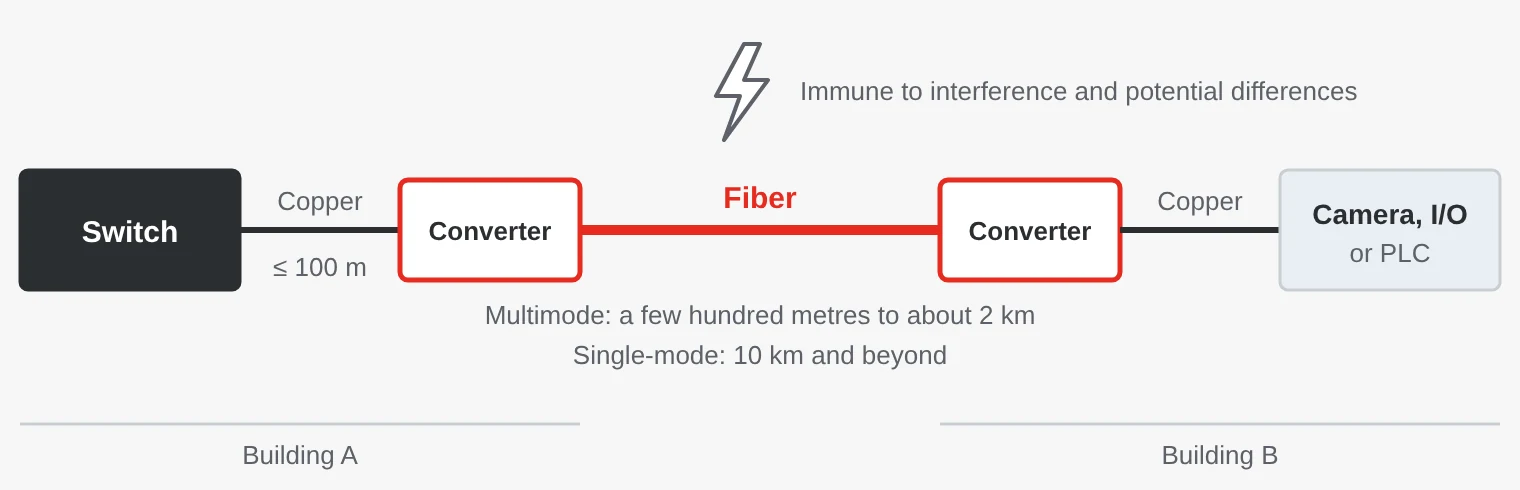
The need usually arises because twisted-pair copper Ethernet is limited to 100 metres – rarely enough between two buildings, along a long conveyor or out to a camera at the gate.
When do you need fiber instead of copper?
- Long distances – links over 100 metres, between buildings, in tunnels and across wind farms.
- Electrical interference (EMC) – near drives, welders, induction furnaces and power cables. Light in the fiber is not affected by electromagnetic fields.
- Potential differences and lightning – buildings at different earth potential can drive current through the cable screen. Fiber does not conduct and breaks the connection.
Examples from different industries
- Factories and process plants – links between control cabinets in different halls, or past drives and welding robots.
- Energy – substations and switchgear, where converters to IEC 61850-3 withstand the electrical environment. Also solar and wind farms with long distances.
- Infrastructure – traffic monitoring, tunnels and pumping stations. Converters with PoE power cameras and access points at the far end of the fiber.
- Railways – along the track and in depots, where fiber handles long runs and interference from the overhead line.
- Vehicles and defence – sealed IP67 converters with military connectors for ships, aircraft and ground vehicles.
- Hospitals and medical technology – fiber between buildings and in areas with interference-sensitive medical equipment.
Single-mode or multimode?
Fiber comes in two main types. In multimode fiber the core is wide and the light travels along several paths, which limits the distance. In single-mode fiber the core is so narrow that the light takes only one path, giving very long reach.
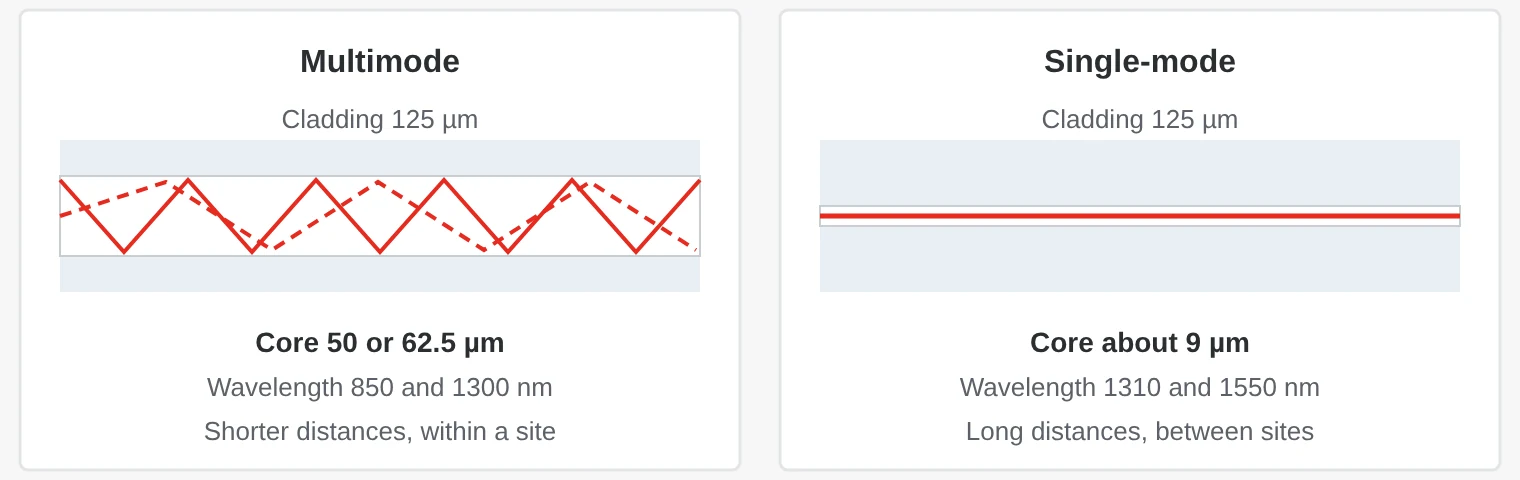
| Multimode | Single-mode | |
|---|---|---|
| Core | 50 or 62.5 µm | About 9 µm |
| Wavelength | 850 and 1300 nm | 1310 and 1550 nm |
| 100 Mbit/s | Up to about 2 km | Tens of kilometres |
| Gigabit | About 220–550 m depending on fiber | 10 km and beyond depending on module |
| Jacket colour | Often orange or aqua | Often yellow |
| Suited to | Within buildings and sites | Between buildings and over long distances |
Start from the fiber already installed on site. If it is multimode, check the category (OM1–OM4), as it affects reach. If new fiber is to be laid, single-mode is often the most future-proof choice.
SFP, connectors and wavelengths
Many converters have an SFP slot instead of a fixed fiber port. An SFP (small form-factor pluggable) is a small exchangeable module that sets fiber type, wavelength and reach. You can then move from multimode to single-mode without replacing the converter. The most common connector on SFP modules is LC, while fixed fiber ports often use SC or ST.
There are also single-fiber modules (WDM or BiDi) that transmit on one wavelength and receive on another, for example 1310 and 1550 nm. They are used in pairs with opposite wavelengths and save one fiber.
Managed or unmanaged – and industrial requirements
Most media converters are unmanaged and work straight away without configuration. A managed converter can be monitored remotely, for example via SNMP or IEEE 802.3ah OAM, and reports link status and faults. It pays off with many links or remote sites.
A good middle ground is Link Fault Pass-Through (LFP). If the fiber link goes down, the converter also shuts the copper port, so the switch sees the fault and can raise an alarm or switch to a backup path.
What an industrial converter should handle
- Temperature – office models are built for room temperature. Industrial versions are available for −40 to 75 °C.
- Mounting and power – DIN rail, metal housing and dual power inputs, often 12–48 V DC.
- Alarms – a relay output that signals power loss or link failure.
- Approvals – for example IEC 61850-3 for substations, EN 50155 for rail vehicles and Class I Division 2 or ATEX Zone 2 for hazardous areas.
| If you need to … | … choose |
|---|---|
| Extend a link within a site | Multimode, or an SFP slot for flexibility |
| Connect buildings or sites several kilometres apart | Single-mode |
| Power a camera or access point far away | Converter with PoE |
| Monitor many links from a central point | Managed converter, preferably in a rack |
| Install outdoors, in vehicles or on ships | Sealed IP67 converter with a wide temperature range |
Five common mistakes
- The ends do not match. Multimode at one end and single-mode at the other, different wavelengths, or 100 Mbit/s against gigabit gives no link. Check both sides before ordering.
- The SFP module cannot handle the environment. A converter rated for −40 °C does not help if the SFP module is only made for room temperature. Choose modules with an industrial temperature range.
- No LFP. Without Link Fault Pass-Through the switch does not notice that the fiber has broken, and redundancy does not switch over.
- Dirty connectors. Dust and grease on end faces commonly cause attenuation and intermittent faults. Clean and inspect connectors during installation.
- Bends too tight. Fiber bent too sharply loses light. Follow the cable manufacturer’s minimum bend radius in cable trays and cabinets.
Media converters from SCN
We supply media converters from Moxa, ORing and Enercon: from compact DIN-rail converters and slide-in rack modules to IP67-rated models for military platforms. Several are available with PoE, an SFP slot and a temperature range down to −40 °C.
Examples from our range
 MoxaIMC-101G Industrial Gigabit Ethernet-to-fiberGigabit converter with SFP slot, LFP, relay alarm output and redundant power inputs. The -T models handle −40 to 75 °C.View product →
 ORingIPMC-111PBFast Ethernet to fiber with SFP slot and IEEE 802.3at PoE up to 30 W, for −40 to 70 °C.View product →
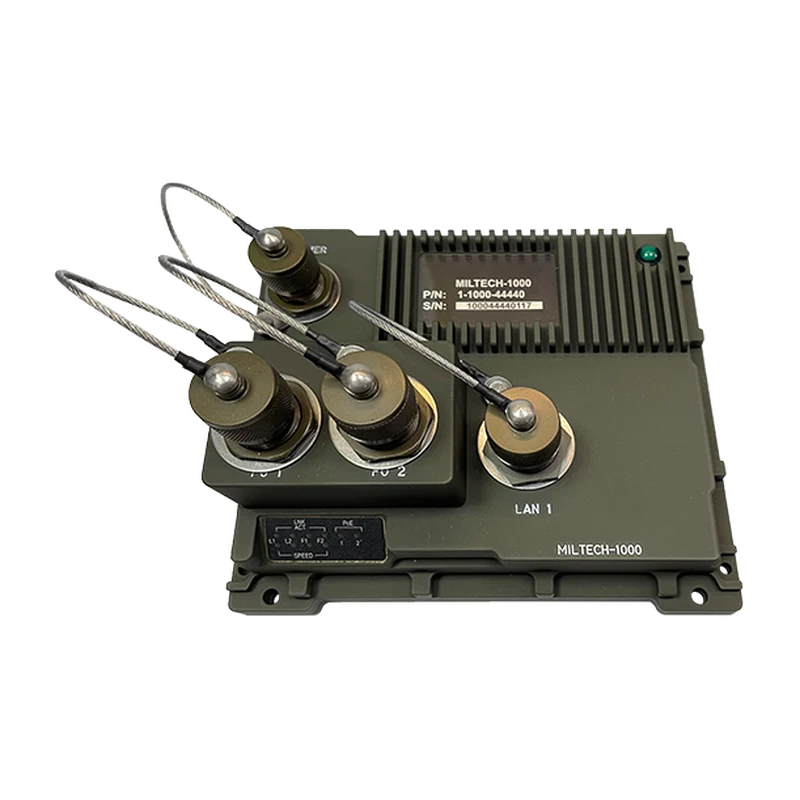 EnerconMILTECH 1000 military Gigabit media converterRugged IP67 gigabit converter with fiber links up to 120 km and cold start from −45 °C.View product →
Erik Ahlqvist is Managing Director of SCN and has spent more than 20 years helping industrial companies choose the right electronics for demanding environments. He holds a BSc in Electronics from KTH Royal Institute of Technology, Stockholm.
LinkedIn profileFrequently asked questions
How far can a media converter reach?
It depends on the fiber and the optics. Multimode reaches from a few hundred metres at gigabit up to about 2 km at 100 Mbit/s. Single-mode normally reaches 10 km or more, and some models over 100 km.
Can you mix single-mode and multimode?
No, both ends of a link must use the same fiber type and wavelength. Joining two different fiber networks takes equipment with a port of each kind, such as a switch with two SFP slots.
Do you always need two media converters?
No. The other end can be a switch or another device with a fiber port or SFP slot. What matters is that fiber type, wavelength and speed match.
What is the difference between a media converter and a switch with a fiber port?
A media converter usually connects one device, with one copper and one fiber port. A switch with a fiber port serves several devices and can add VLANs and redundancy.
Does a media converter delay real-time traffic?
The delay is small, from a few microseconds up to around a tenth of a millisecond depending on speed and frame size. It normally does not affect PROFINET or EtherNet/IP.
More guides on Network Products
All guides →Unsure about fiber type, reach or SFP? Tell us about the route and the environment – you get an answer within 24 hours.
Ask us