




Photoelectric sensor types – how to choose the right one
A photoelectric sensor detects objects with light, from a few millimetres to tens of metres away. This guide covers the basic types, how to handle shiny, transparent and dark objects and when you need a laser distance sensor.
 By Erik Ahlqvist, Managing Director of SCN · Updated 24 October 2026 · 7 min read
- Through-beam – emitter and receiver facing each other. Longest range and most reliable in dirty conditions, but two units to mount.
- Retro-reflective – sensor and reflector. Only one unit to wire. Choose polarised retro-reflective for shiny objects.
- Diffuse – light bounces off the object. Nothing on the other side, but range depends on the colour of the object.
- Background suppression – ignores everything beyond a set distance. Best when colours vary or the background is bright.
- Laser distance sensor – when you need a measured value in millimetres, not just on or off.
What is a photoelectric sensor?
A photoelectric sensor has a light source and a receiver. When an object breaks or reflects the light, the output switches. Photoelectric sensors are used where objects are too far away, too small or of the wrong material for an inductive sensor: boxes on a conveyor, bottles, labels, pallets or vehicles in a gateway.
The light is usually visible red, which makes alignment easy, or infrared. There are four basic types, and the choice depends on how you can mount the sensor and what the objects look like.
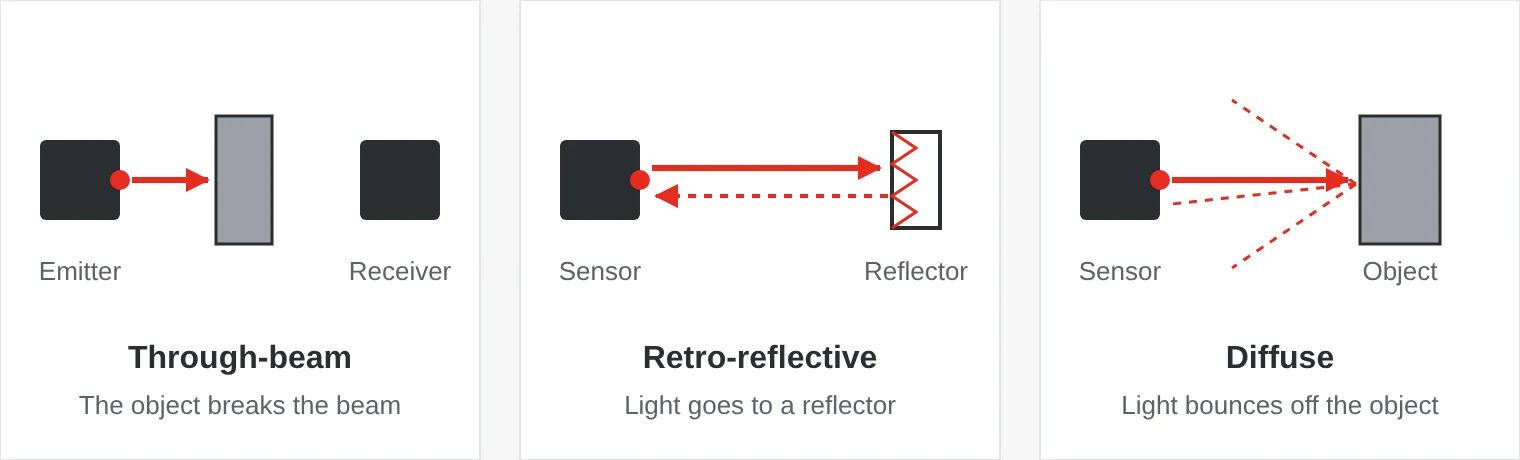
Through-beam, retro-reflective or diffuse?
| Type | How it works | Typical range | Good for |
|---|---|---|---|
| Through-beam | Emitter and receiver face each other. The object breaks the beam. | Up to tens of metres | Long distances, dirt and dust, small objects in slot sensors |
| Retro-reflective | The sensor sends light to a reflector and detects when the beam is broken. | A few metres | Conveyors and gates where cable can only be run on one side |
| Diffuse | Light bounces off the object back to the sensor. | A few centimetres to a couple of metres | Objects where nothing can be mounted on the other side |
| Background suppression | A diffuse sensor that measures the angle of the reflected light and only switches within a set distance. | A few millimetres to a couple of metres | Objects of varying colour, in front of a bright or shiny background |
The range of diffuse sensors is stated against a white reference card. A black object gives a much shorter range, sometimes only a fraction. A slot sensor is a through-beam sensor with emitter and receiver in one housing, for labels, edges and small parts.
Background suppression and laser distance sensors
A standard diffuse sensor measures how much light comes back. So a white object far away can trigger it as easily as a black one close by. With background suppression, the receiver instead sees where the light spot lands, and the sensor calculates the distance by triangulation. Everything beyond the set distance is ignored, however bright it is.
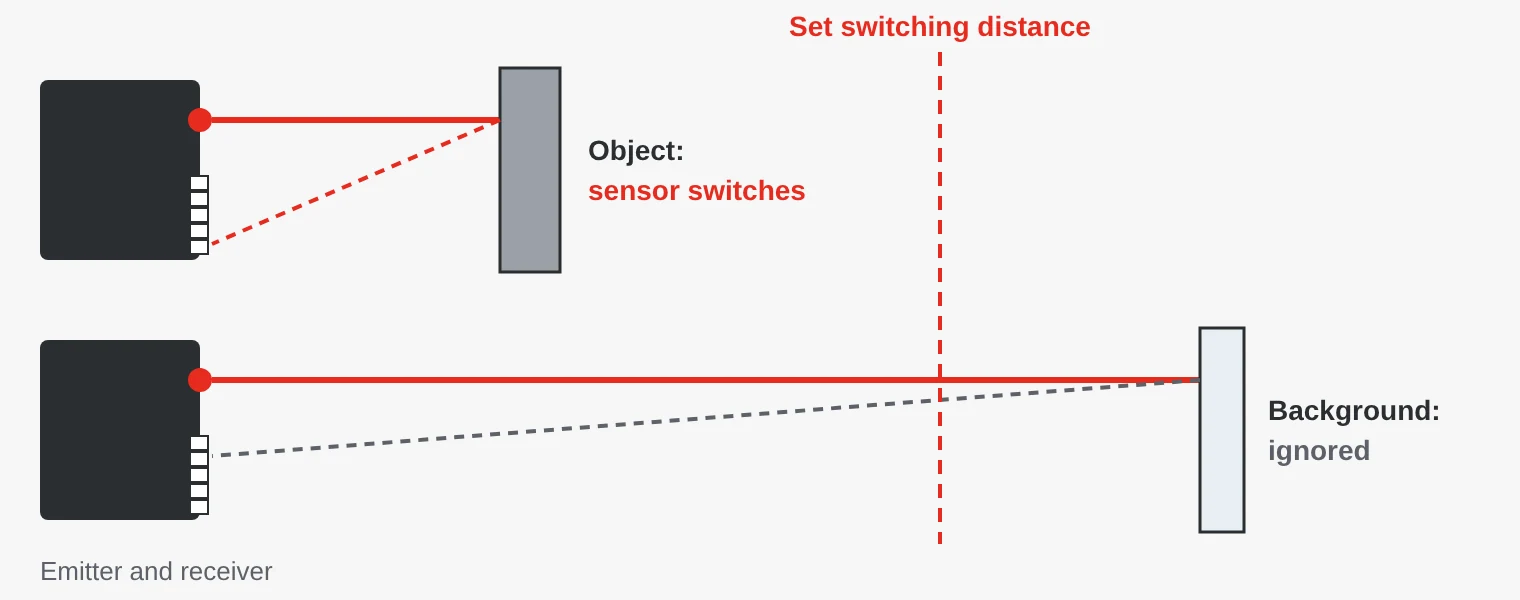
A laser distance sensor goes one step further and outputs the distance as a value, such as 4–20 mA, 0–10 V or via IO-Link. Triangulation gives high resolution at short range, down to micrometres. For longer ranges, up to several metres, the time of flight of the light is measured. Laser class 1 is eye-safe in normal use.
Difficult objects: shiny, transparent and dark
- Shiny objects – a shiny surface can reflect the light back and fool a standard retro-reflective sensor. A polarised sensor only accepts light that has been rotated by the prisms of the reflector, so shiny surfaces are ignored.
- Transparent objects – glass and PET bottles let most of the light through. Use a sensor designed for clear objects, which reacts when only a small part of the light is lost.
- Dark and matt objects – reflect little light. Background suppression or a laser distance sensor helps. Some laser sensors with blue light are designed for dark, shiny and hot surfaces.
- Small objects – choose a small, visible light spot. A 1–3 mm spot sees a thin wire or a small hole that a wide beam misses.
Rule of thumb: the more your objects vary in colour, gloss and shape, the stronger the case for through-beam or background suppression.
Light-on, dark-on and common mistakes
Light-on means the output is active when the receiver gets light, dark-on that it is active when the light is gone. For a through-beam or retro-reflective sensor, dark-on gives a signal when the object breaks the beam. For a diffuse sensor it is the other way round. Many sensors can be switched with a wire, a button or via IO-Link.
Also check PNP or NPN, response time for fast lines, and the excess gain – how much more light than needed reaches the receiver. In dust and moisture you need a large margin, or the sensor stops working when the lens gets dirty.
- Range quoted against white paper. The datasheet range for diffuse sensors applies to a white card. Dark objects need a shorter distance.
- Standard retro-reflective on shiny objects. Cans, foil and shiny metal reflect the light. Choose a polarised sensor.
- The wrong reflector. Polarised sensors need a prism reflector. The wrong tape or foil can make operation unreliable.
- No margin for dirt. Choose a sensor with good excess gain, or read the signal quality via IO-Link.
- Interfering light. Sunlight, flashing lights or another sensor opposite can interfere. Angle the sensors so they do not see each other.
Where are photoelectric sensors used?
- Packaging and food – counting products, reading label edges with slot sensors, checking that caps are on.
- Logistics and warehousing – detecting boxes and pallets on conveyors, measuring height, checking bays in automated storage.
- Vehicles and mobile machines – laser distance sensors for distance and position on forklifts and cranes.
- Infrastructure – gates, barriers and doors that must detect vehicles in the opening.
- Electronics and precision assembly – small components at close range.
- Sawmills and steel – measuring position, width and thickness of boards and plate with lasers.
Photoelectric and laser distance sensors from SCN
We carry photoelectric sensors from Mibbo and Wenglor: slot sensors, through-beam, retro-reflective and diffuse sensors, background suppression with IO-Link, and laser distance sensors using triangulation or time of flight, from 30 mm up to 10 m.
Examples from our range
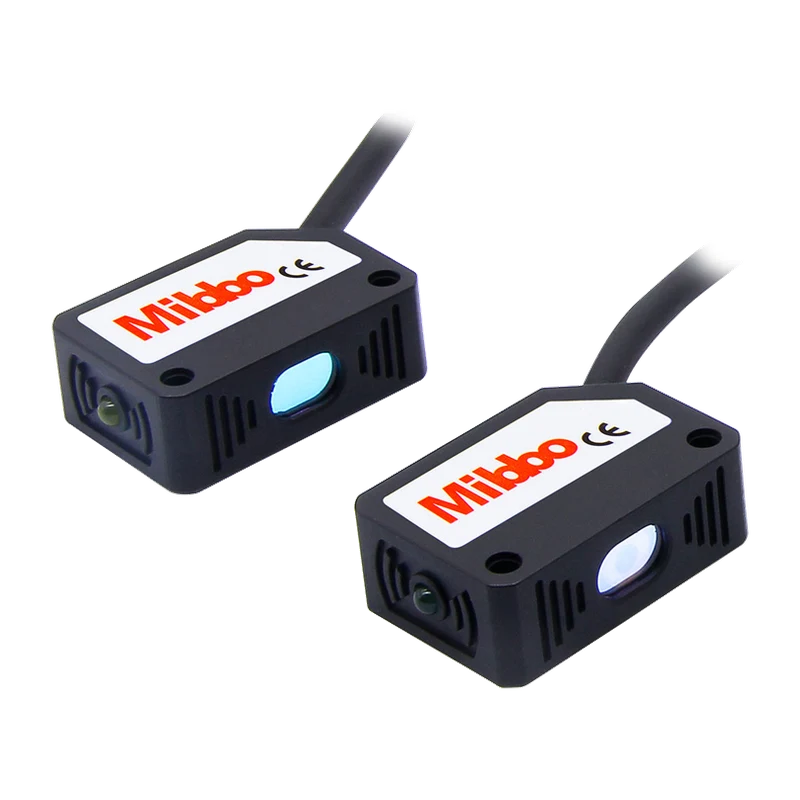 MibboPC27 Small-Spot Compact Photoelectric SensorVisible 1–3 mm light spot for small parts. Available as diffuse, retro-reflective up to 8 m and through-beam up to 30 m.View product →
 WenglorHK12PA diffuse sensorBackground suppression by triangulation, 0–120 mm, unaffected by colour and surface. IO-Link and IP67.View product →
 WenglorP1PY217, Laser Distance Sensor Time of FlightBlue-light time-of-flight laser distance sensor, 50–5,000 mm, for dark, shiny, transparent and hot surfaces.View product →
Erik Ahlqvist is Managing Director of SCN and has spent more than 20 years helping industrial companies choose the right electronics for demanding environments. He holds a BSc in Electronics from KTH Royal Institute of Technology, Stockholm.
LinkedIn profileFrequently asked questions
What is the difference between through-beam and retro-reflective?
A through-beam sensor has emitter and receiver in two units facing each other. A retro-reflective sensor has both in one housing and a reflector on the other side. Through-beam reaches further and tolerates more dirt, retro-reflective is easier to install.
Can a photoelectric sensor detect glass?
Yes, but choose a sensor designed for transparent objects. Standard sensors see straight through clear glass and plastic.
What do light-on and dark-on mean?
Light-on: the output is active when the receiver gets light. Dark-on: the output is active when the light is gone, for example when an object breaks the beam.
How far can a photoelectric sensor reach?
Diffuse sensors reach from a few centimetres to a couple of metres, retro-reflective sensors a few metres and through-beam sensors up to 50 metres or more.
What is background suppression?
A technique where the sensor measures distance by triangulation and only switches for objects within a set distance. Bright objects further away are ignored.
Do you have an object that is hard to detect? Describe it and the environment, and we will suggest a solution – you get an answer within 24 hours.
Ask us