




Medical panel PC – IEC 60601-1 and computers in healthcare
A computer at the bedside must be electrically safe, withstand daily disinfection and not interfere with other medical equipment. This guide explains what IEC 60601-1 and IEC 60601-1-2 require – and when an ordinary PC is enough.
 By Erik Ahlqvist, Managing Director of SCN · Updated 24 October 2026 · 7 min read
- IEC 60601-1 – the safety standard for medical electrical equipment: insulation, leakage currents and protection of patients and staff.
- IEC 60601-1-2 – EMC: the equipment must not disturb other medical devices and must withstand interference, for example from mobile phones.
- Patient environment – about 1.5 metres around the patient. Stricter requirements apply there, even to computers that are not medical devices.
- Hygiene – a sealed front, smooth surfaces and materials that withstand hospital disinfectants.
- A certified PC is not the same as a medical device – responsibility under the MDR lies with the manufacturer of the end product.
Why are special computers needed near the patient?
Ordinary computers and monitors are built to IEC 62368-1, the standard for IT equipment. That is enough at reception and in offices. Near the patient things are different. The patient may be connected to other equipment, be unable to react or have reduced skin resistance. Surfaces are wiped with strong agents several times a day, and the computer stands next to monitoring equipment that must not be disturbed.
That is why healthcare requires lower leakage currents, better insulation, tougher surfaces and controlled EMC. A medical panel PC is built for exactly that – and is often fanless and silent.
What do IEC 60601-1 and IEC 60601-1-2 require?
Electrical safety: MOOP and MOPP
IEC 60601-1 (EN 60601-1 in Europe) is the core standard for the safety of medical electrical equipment. The current version is the third edition with amendments from 2012 and 2020. It distinguishes between protection of the operator, MOOP (Means of Operator Protection), and protection of the patient, MOPP (Means of Patient Protection). MOPP is stricter, with a higher test voltage and longer creepage distances.
| Protection level | Test voltage | Creepage at 240 V |
|---|---|---|
| 1 × MOOP | 1,500 V AC | 2.5 mm |
| 2 × MOOP | 3,000 V AC | 5 mm |
| 1 × MOPP | 1,500 V AC | 4 mm |
| 2 × MOPP | 4,000 V AC | 8 mm |
The standard also limits leakage currents. Touch current from the enclosure, for example, may be at most 100 µA in normal condition and 500 µA in a single fault condition, such as a broken protective earth. Ordinary IT equipment can have protective conductor currents of several milliamperes.
EMC to IEC 60601-1-2
IEC 60601-1-2 covers electromagnetic compatibility. The current version is edition 4.1 from 2020. Requirements are based on where the equipment is used: professional healthcare facilities, home healthcare or special environments. Home use has higher immunity requirements, and the standard requires tests against nearby radio transmitters such as phones and tablets. Medical keyboards and mice are often tested to it too.
The patient environment and isolation transformers
IEC 60601-1 defines the patient environment as the space where the patient can come into contact with equipment, directly or through another person. In practice it is about 1.5 metres around the bed or couch and up to 2.5 metres high.
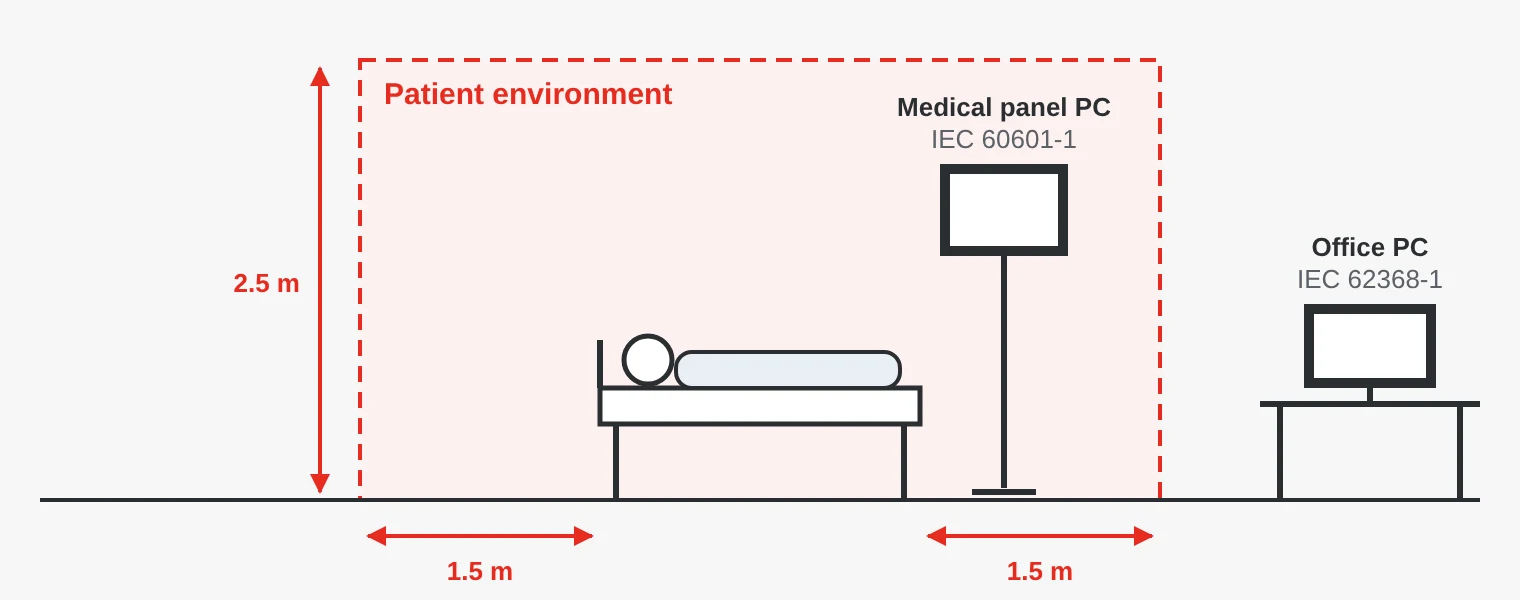
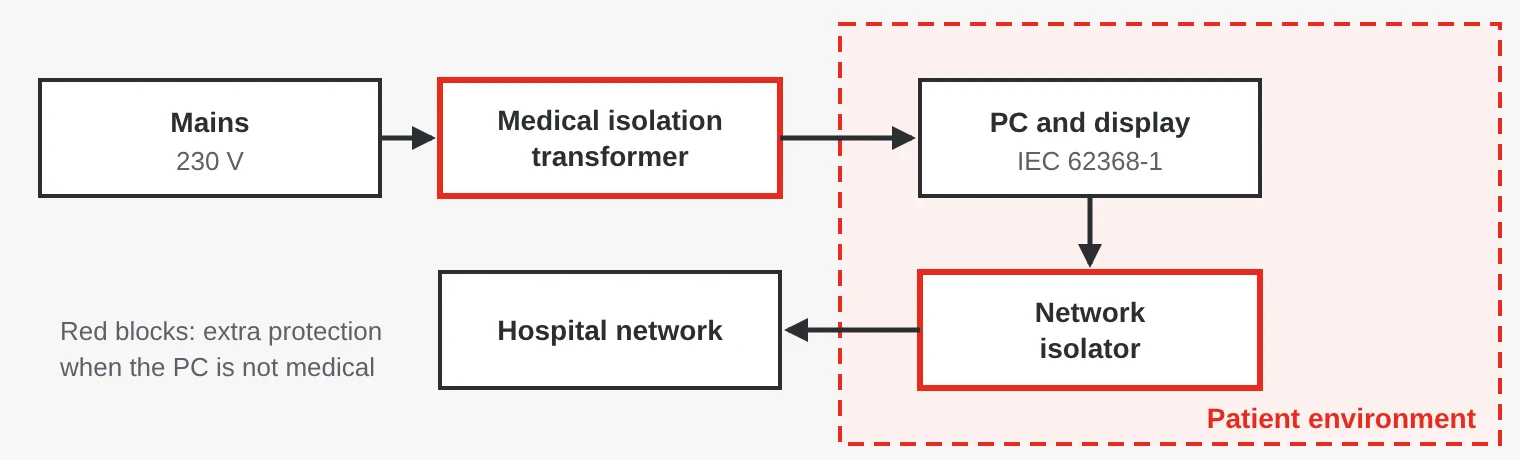
When an ordinary PC is connected to medical equipment, by cable or through the same power strip, it forms a medical electrical system under clause 16 of IEC 60601-1. The whole system must then meet the requirements of the patient environment. There are two ways to solve this. Either choose a PC certified to IEC 60601-1, or power the ordinary PC through a medical isolation transformer and isolate the network cable with a network isolator. The hospital’s medical engineering department decides which solution applies.
Hygiene: sealed front and durable surfaces
A panel PC in healthcare is wiped down many times a day. Look for an IP65 or IP66 front and a completely flat glass surface without edges where dirt can collect. Projected capacitive touch (PCAP) often works with gloves and is easy to wipe. Fanless computers do not circulate air and dust.
Ask the manufacturer which disinfectants and concentrations the housing has been tested with, for example alcohol, quaternary ammonium compounds, hydrogen peroxide or chlorine compounds. Some housings have an antibacterial treatment. It reduces bacterial growth on the surface but never replaces cleaning. Silicone keyboards and mice rated IP68, with a key lock for cleaning, make it easier to keep the whole workstation clean.
Medical device or not?
Under the EU Medical Device Regulation, MDR (EU) 2017/745, the manufacturer’s intended purpose decides whether something is a medical device. A panel PC used for patient records or at a nurses’ station is usually not one, even if it is certified to IEC 60601-1. The certification shows that the PC is electrically safe and EMC-tested for healthcare.
If you build your own product that includes the PC, such as an ultrasound or endoscopy system, you as the manufacturer are responsible for the MDR, risk analysis and documentation. A certified PC makes the work easier but does not replace it. Software can also be a medical device in its own right. Get help from a regulatory expert for your assessment.
Where are medical computers used?
- Wards – bedside terminals for patient information and entertainment, records at the bedside and nurses’ stations.
- Operating theatres and intensive care – wall-integrated panel PCs, battery-powered cart computers and displays for surgical video.
- Imaging and laboratories – computers with graphics cards for image processing and AI, medical displays.
- Medical device industry – computers built into ultrasound, endoscopy and analysis instruments.
- Ambulance and home care – medical tablets and mobile workstations.
Five pitfalls
- An ordinary power strip. A power strip from the hardware store has no place in a medical electrical system. Use an isolation transformer or an approved socket outlet.
- Only the PC is certified. Monitors, power supplies and accessories in the patient environment must meet the requirements too.
- Modules added later. A new Wi-Fi or 4G module can change the EMC behaviour. Check that the configuration has been tested.
- The wrong disinfectant. Strong agents can make plastic brittle and damage the screen coating. Follow the manufacturer’s list.
- Reading the certificate as MDR CE marking. IEC 60601-1 shows electrical safety, not that the product is a medical device.
Medical computers from SCN
We supply medical panel PCs, box PCs and displays from brands such as IEI, Baaske Medical, Onyx Healthcare and Axiomtek, as well as hygienic keyboards and mice from Indukey. The product pages state which standards each product is certified to.
Examples from our range
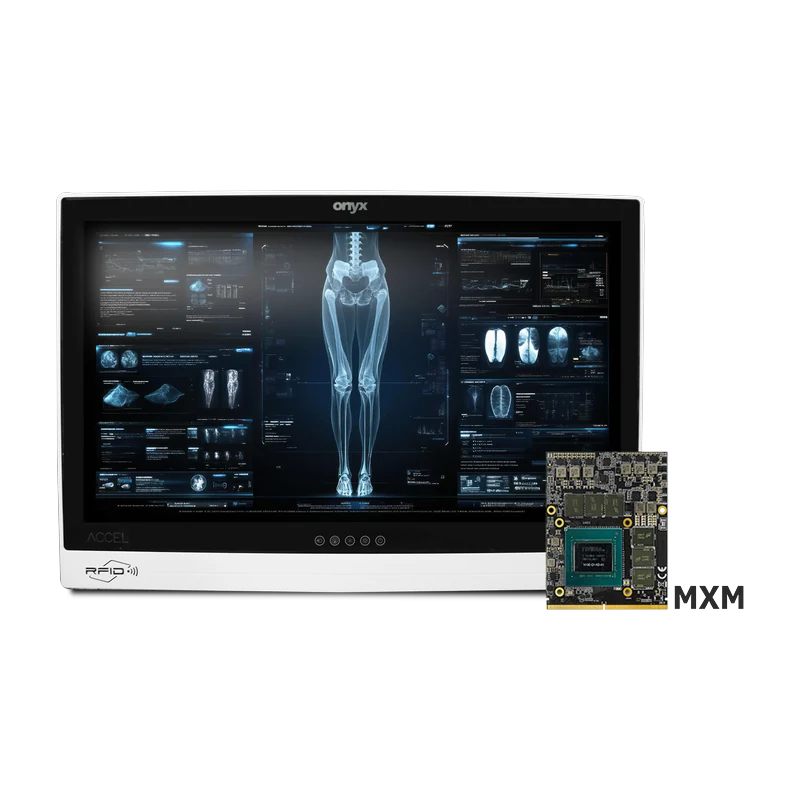 Onyx HealthcareACCEL-A2720 27" 4K Medical AI All-in-One PC27-inch 4K all-in-one with IP65 front and NVIDIA graphics, for endoscopy and surgical visualisation.View product →
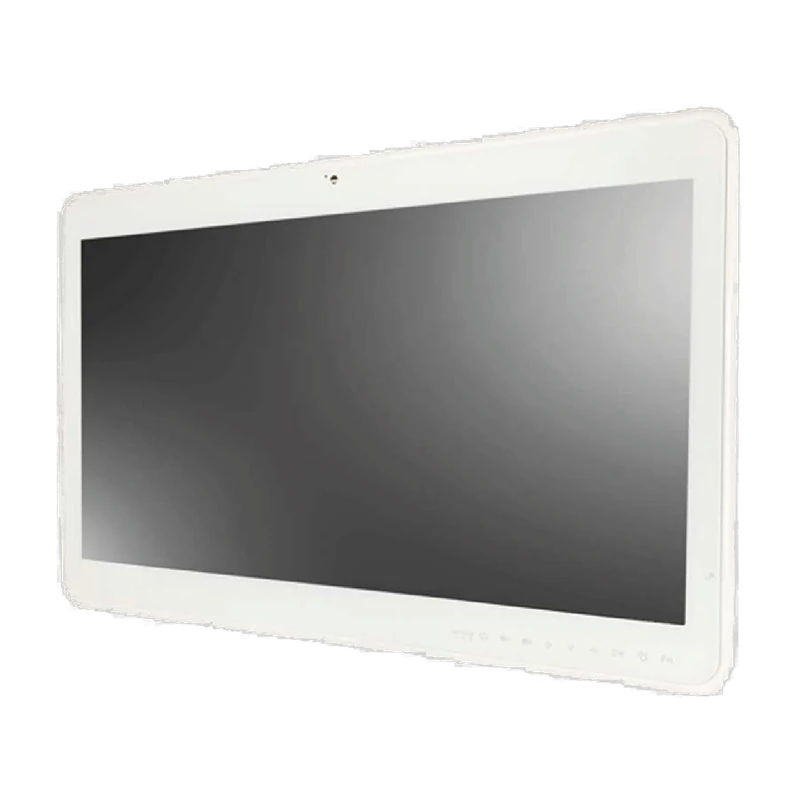 Baaske Medicale-medic Silence TP-22P/TP-24P Medical Panel PCSealed, fanless panel PC for operating theatres and intensive care, with IP65 front and IP54 rear.View product →
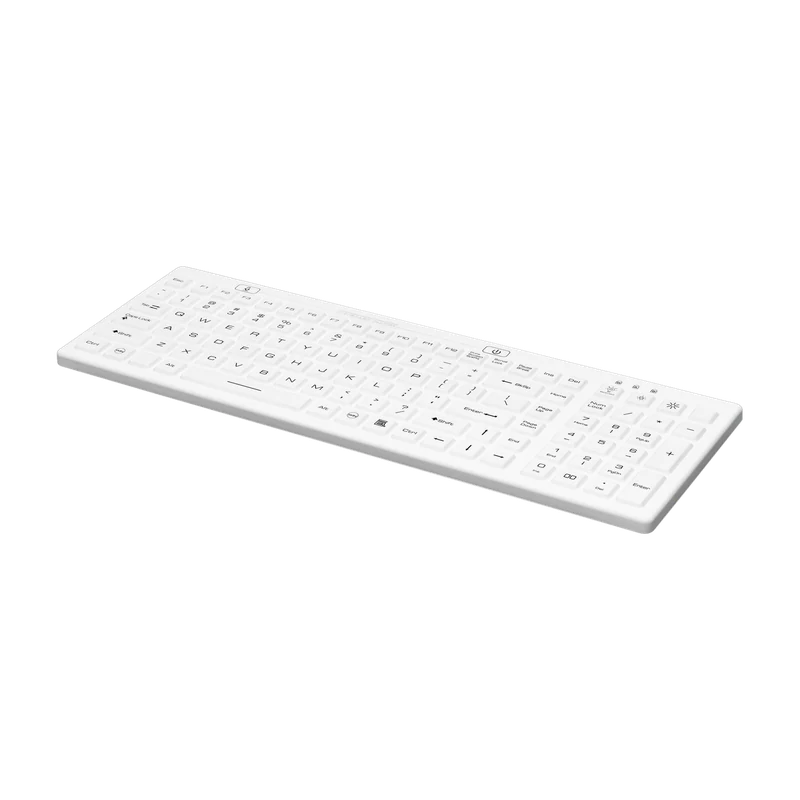 IndukeyTKG-110-GCQ-MED-IP68-BACKL-WHITE medical keyboardWashable IP68 silicone keyboard with a key lock for cleaning, certified to IEC 60601-1-2.View product →
Erik Ahlqvist is Managing Director of SCN and has spent more than 20 years helping industrial companies choose the right electronics for demanding environments. He holds a BSc in Electronics from KTH Royal Institute of Technology, Stockholm.
LinkedIn profileFrequently asked questions
What is IEC 60601-1?
The international core standard for the safety of medical electrical equipment. It sets requirements for insulation, leakage currents, temperature and mechanical safety.
What is the difference between MOOP and MOPP?
MOOP protects the operator, MOPP protects the patient. MOPP requires a higher test voltage and longer creepage distances, because the patient may be more vulnerable.
Does a computer in healthcare have to be certified to IEC 60601-1?
Not always. Outside the patient environment IEC 62368-1 is normally enough. Inside it you need either an IEC 60601-1 certified PC or extra protection such as an isolation transformer.
Is a medical panel PC a medical device?
Usually not on its own. That is decided by the intended purpose under the MDR. IEC 60601-1 certification shows that the PC is electrically safe in healthcare settings.
What counts as the patient environment?
The space where the patient can come into contact with equipment, directly or through another person. In practice about 1.5 metres around the patient and up to 2.5 metres high.
More guides
All guides →Choosing a computer for a healthcare setting or for your own medical device? Ask us – you get an answer within 24 hours.
Ask us