




LED work lights for vehicles and machines
Good work lights make it safer and easier to work in darkness, rain and dust. This guide shows how to choose luminous flux, beam pattern, voltage and ingress protection, and which approvals apply to vehicles and machines.
 By Erik Ahlqvist, Managing Director of SCN · Updated 24 October 2026 · 8 min read
- Lumens are not everything – the beam pattern decides where the light goes. Spot reaches far, flood lights wide and close.
- Colour – 5000–6500 K is most common. High colour rendering makes it easier to tell cables, hoses and markings apart.
- Voltage – lamps for 9–32 V suit both 12 and 24 V. Electric forklifts and rail vehicles may need higher voltages.
- E-mark (UNECE R10) – shows the lamp meets vehicle EMC requirements, so it does not disturb radio and electronics.
- IP67 and IP69K – withstand immersion and high-pressure hot-water washing respectively.
Lumens, candela and lux – what do the figures mean?
Lumen (lm) is the luminous flux, the total amount of light the lamp emits. Many manufacturers quote raw lumens, calculated from the LEDs. Effective lumens account for losses in optics and lens and are always lower. Compare like with like.
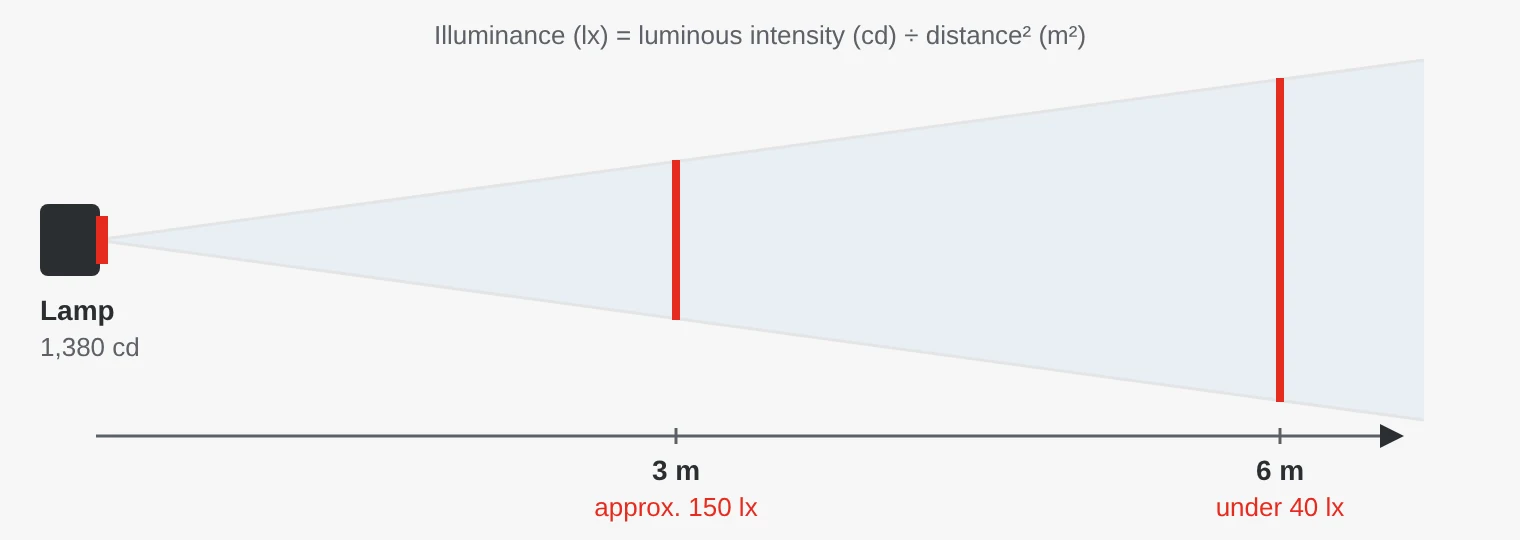
Candela (cd) is the luminous intensity in a given direction and lux (lx) the amount of light reaching a surface. Illuminance falls with the square of the distance: 1,380 cd gives about 150 lx at 3 metres but under 40 lx at 6 metres.
Small lamps of 500–1,500 lm suit step and close-range lighting. Large machines often carry several lamps or light bars of several thousand lumens each.
Beam pattern: spot, flood or wide?
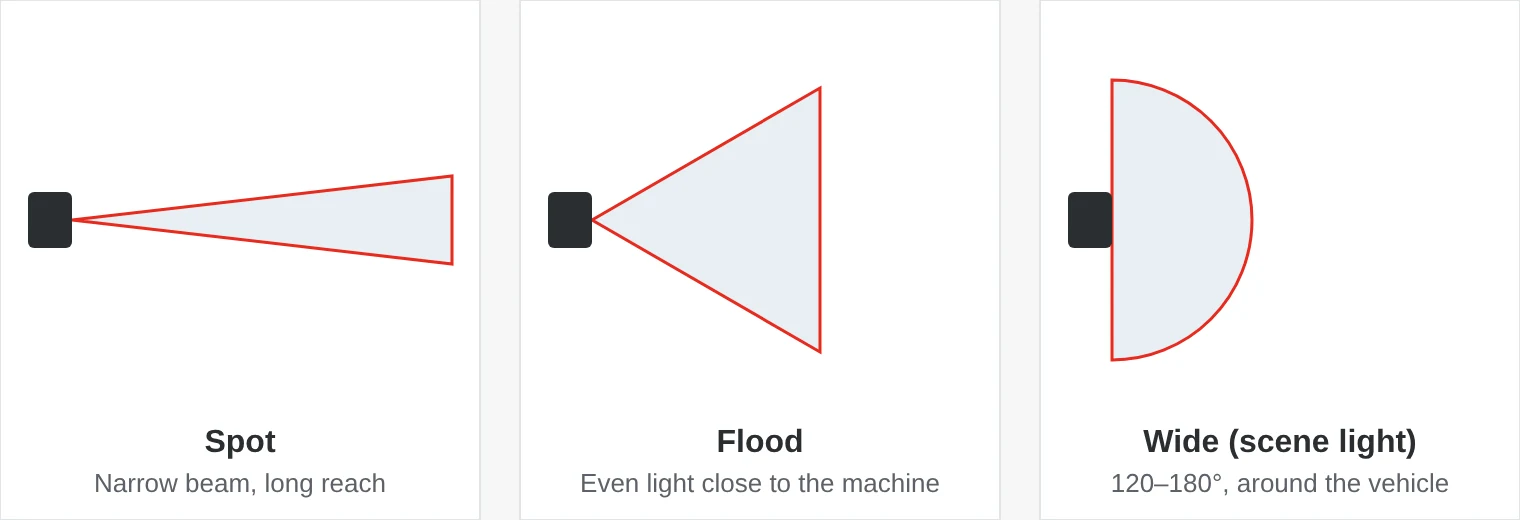
The lens or reflector decides the beam pattern. The choice depends on where and how far away you need light.
| Beam pattern | How the light spreads | Suits |
|---|---|---|
| Spot | Narrow beam that reaches far | Long-range lighting, e.g. on forestry and mining machines |
| Flood | Wide, even light close to the lamp | The work area around excavators, tractors and trucks |
| Wide (scene light) | 120–180°, light spread along the vehicle | Emergency vehicles, service vans and loading bays |
| Combination | Spot and flood in one lamp or bar | Light bars on work vehicles |
A common set-up is flood to the front and sides where the operator works, and spot where you need to see far.
Colour temperature and colour rendering
Colour temperature is given in kelvin. Vehicle work lights are usually 5000–6500 K, a cool white close to daylight that gives good contrast. Warmer light, around 3000–4000 K, is often perceived as less dazzling when rain, snow or dust reflect the light.
Colour rendering is given as Ra or CRI, where 100 equals daylight. A value of 70 or more is enough for most tasks, but anyone who needs to tell colour-coded cables, hydraulic hoses or timber grades apart benefits from a higher value.
Voltage, EMC and approvals
Most work lights handle both 12 and 24 V, often with a range such as 9–32 V or 10–30 V. Electric forklifts and mining machines often have higher battery voltages, and rail vehicles run on 24, 72 or 110 V DC. Check that the lamp handles the voltage in the vehicle.
An LED lamp has a driver that switches the current. A poor driver can interfere with FM and DAB radio and two-way radio. An E-mark to UNECE Regulation No. 10 (R10) shows the lamp has been EMC-tested for road vehicles. The mark consists of an E, a number for the approving country and an approval number.
| Regulation | Covers |
|---|---|
| UNECE R10 | EMC for vehicles and components, gives the E-mark. Also applies to work lights. |
| UNECE R148 | Light-signalling devices such as reversing, position and direction indicator lamps. Replaces older regulations such as R23 for reversing lamps. |
| UNECE R149 | Road illumination devices: headlamps, front fog lamps and auxiliary driving lamps. |
| UNECE R65 | Special warning lamps, such as amber and blue beacons. |
| ADR | Requirements for electrical equipment in vehicles carrying dangerous goods, such as tankers. |
| EN 50155 and EN 45545-2 | Electronics and fire protection on rolling stock. |
Work lights are not type-approved for lighting the road while driving and should be used when the vehicle is working. In Sweden, for example, white light to the rear may only be used when reversing or for work that requires it.
Sealing, vibration, heat and service life
IP67 means the lamp is dust-tight and withstands temporary immersion in water. IP69K, sometimes written IP6K9K, comes from the vehicle standard ISO 20653. The lamp must withstand high-pressure washing with 80 °C water at 80–100 bar at close range. That matters on machines that are washed often, for example in agriculture, food transport and mining.
Vibration and shock wear out solder joints and brackets. Choose lamps with die-cast aluminium housings, potted electronics and a sturdy bracket. Polycarbonate lenses withstand stone chips but should have a UV-resistant coating so they do not yellow.
LEDs are sensitive to heat. The heat is carried away through the lamp’s cooling fins, and some lamps reduce their output automatically when they get too hot. Service life is often given as L70, the number of hours until the luminous flux has fallen to 70 % of its initial value.
An LED lamp gives off almost no heat forwards. Snow and ice therefore do not melt off the lens as they do on a halogen lamp. For snow clearing and winter use there are lamps with a heated lens.
Mounting, glare and warning lights
Mount the lamps high and aim them down at the work area. Avoid lighting the machine’s own parts, such as the boom or bonnet, as that causes reflections and shadows. Do not aim the light at the cab or at others working nearby. In dust and snow, lamps mounted some distance from the operator’s line of sight cause less glare from reflected light. Make sure cables and connectors, such as Deutsch DT or AMP Superseal, have the same sealing class as the lamp.
Beacons, light bars and directional arrow bars warn others of a vehicle that is stopped or working on the road. In Europe they are approved to UNECE R65. Amber is used on work vehicles such as recovery trucks, snowploughs and service vehicles, while blue is reserved for emergency vehicles. North American products are often marked SAE Class 1 instead.
Application examples and common mistakes
- Agriculture and forestry – tractors, combine harvesters and forestry machines working long shifts in the dark.
- Construction – excavators, wheel loaders and dumpers with high demands on sealing and vibration resistance.
- Mining – light bars with very high output and a wide voltage range.
- Forklifts and warehouses – a blue warning spot on the floor ahead of the forklift tells pedestrians it is approaching.
- Rescue and service vehicles – scene lighting around the vehicle, combined with warning lights.
- Rail – lighting for bogies and work areas under the train, to EN 50155.
- Comparing raw with effective lumens. The figures are not comparable. Ask for lux at a given distance instead.
- Wrong beam pattern. Spot where you need flood gives bright patches and dark zones.
- Cheap lamp without an E-mark. Radio interference is often only discovered once the lamp is on the machine.
- IP67 on a machine that is pressure-washed. IP67 is not tested for high-pressure washing. Choose IP69K.
- Wrong voltage. A 9–32 V lamp cannot handle the battery voltage of a 48 or 80 V forklift.
LED lighting from SCN
We supply work lamps, light bars and scene lights from Proplast and work lights, beacons and warning bars from Ecco Safety. For rail vehicles we offer lighting and signal lights from Mafelec.
Examples from our range
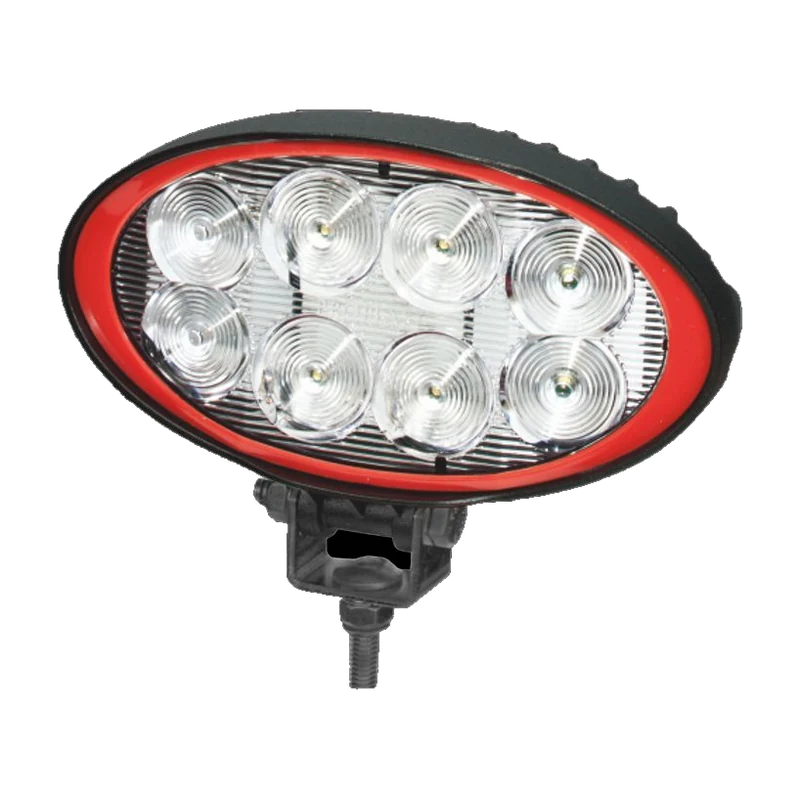 ProplastPRO-WORK II LED Work Lamp 2500–3500 lmOval long-range work lamp for trucks, tractors and construction machines: 12–36 V, IP6K9K, ADR and EMC approved.View product →
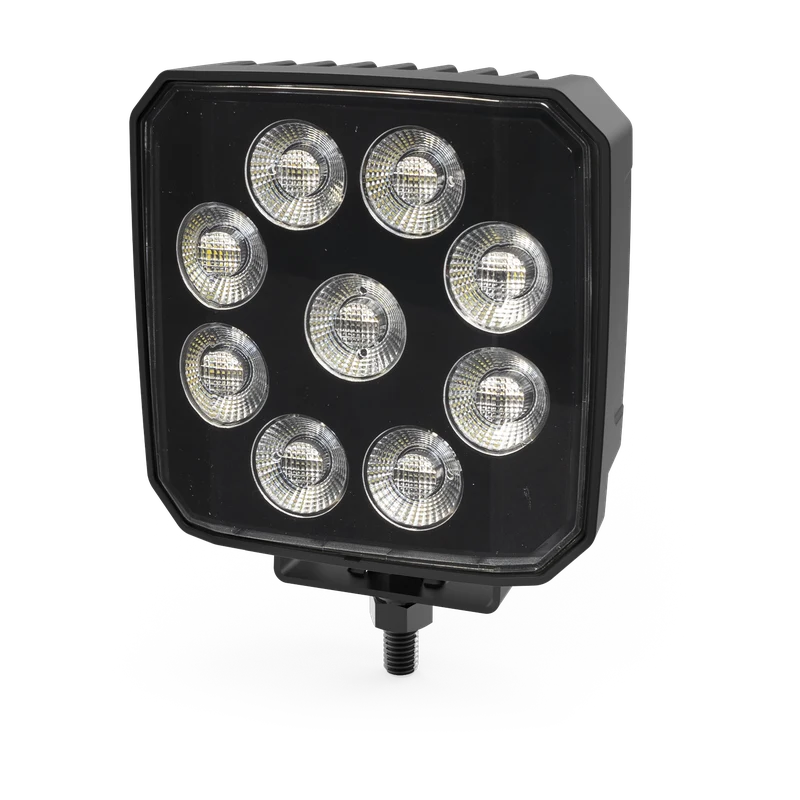 Ecco SafetyE92006H Heated LED Worklight, 2320 lmHeated lens that melts snow and ice, 2320 lm flood, 12–24 V, IP67 and IP69K, ECE R10 – for snowploughs and tow trucks.View product →
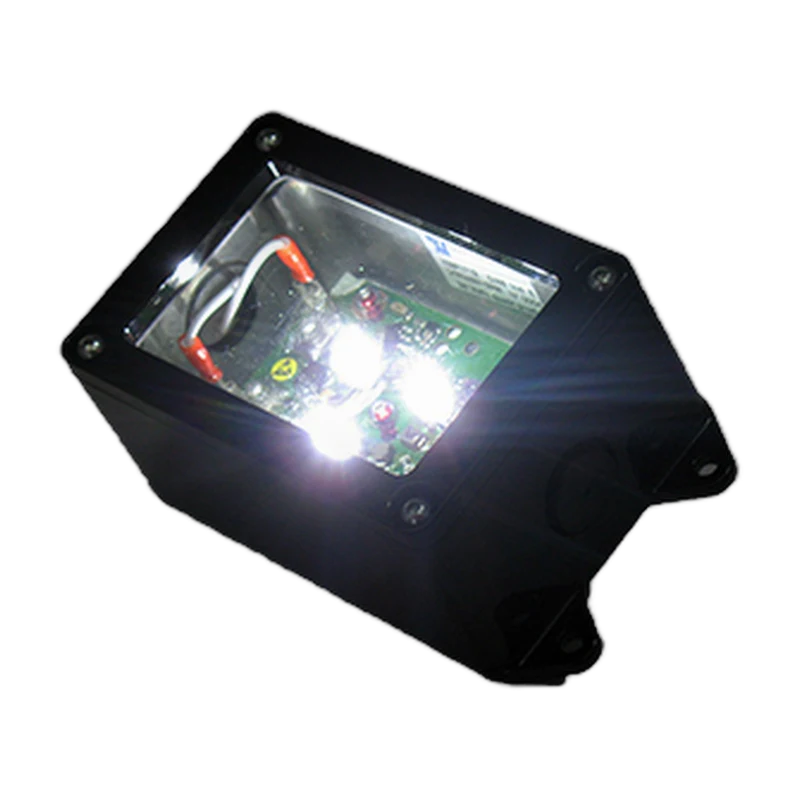 MafelecLED lighting box for rail bogie areaUnder-body lighting for rail vehicles at 24, 72 or 110 V DC, IP66 and −50 to +70 °C, with anti-fog system and EN 50155.View product →
Erik Ahlqvist is Managing Director of SCN and has spent more than 20 years helping industrial companies choose the right electronics for demanding environments. He holds a BSc in Electronics from KTH Royal Institute of Technology, Stockholm.
LinkedIn profileFrequently asked questions
How many lumens does a work light need?
It depends on distance and area. 500–1,500 lm is enough for close-range lighting, while large machines often carry several lamps of several thousand lumens. Lux on the work surface is a better measure than lumens.
What is the difference between spot and flood?
Spot concentrates the light in a narrow beam that reaches far. Flood spreads the light wide and evenly close to the lamp.
What does an E-mark on a work light mean?
That the lamp is type-approved for EMC to UNECE R10 and does not disturb the vehicle’s radio and electronics beyond permitted levels. It does not mean it is approved as a headlamp.
What is the difference between IP67 and IP69K?
IP67 withstands temporary immersion in water. IP69K withstands high-pressure hot-water washing at close range. Lamps that must handle both are marked with both ratings.
Why does snow build up on LED lights?
The LEDs give off almost no heat forwards, so the lens stays cold. Lamps with a heated lens keep it clear of snow and ice.
Need help choosing work lights for a machine or a vehicle series? Ask us – you get an answer within 24 hours.
Ask us