




What is a PLC? How it works and how to choose one
A PLC is an industrial computer that reads sensors, makes decisions according to a program and controls motors, valves and lamps – over and over, a few milliseconds at a time. Here is how it works, which programming languages exist and how to choose a system.
 By Erik Ahlqvist, Managing Director of SCN · Updated 24 October 2026 · 7 min read
- PLC – Programmable Logic Controller, a programmable control system built to run machines and processes around the clock.
- Scan cycle – the PLC reads all inputs, runs the program, writes all outputs and starts again. One cycle often takes a few milliseconds.
- Languages – the IEC 61131-3 standard defines LD, FBD, ST and SFC. Instruction List (IL) has been phased out.
- Compact, modular or distributed – choose by I/O count, need for expansion and how spread out the plant is.
- Look at the whole picture – I/O, communication, software and what your technicians already know, not just the CPU price.
What is a PLC?
PLC stands for Programmable Logic Controller. It appeared in the late 1960s to replace large relay cabinets in the car industry. Instead of rewiring when a machine changed, engineers could change the program.
A PLC is built for industry: it withstands vibration, electrical noise and heat in the control cabinet, and runs the same program around the clock for years. A PLC system consists of:
- CPU – the processor that runs the program and holds the memory.
- Inputs – digital (24 V DC from buttons and sensors) and analogue (4–20 mA, 0–10 V, temperature).
- Outputs – transistor or relay outputs to valves, contactors and lamps, and analogue outputs to drives and control valves.
- Communication – fieldbuses and industrial Ethernet to operator panels, drives and higher-level systems.
- Power supply – usually 24 V DC.
Where are PLCs used?
- Manufacturing – packaging machines, conveyors, robot cells, presses and test rigs.
- Food and process – dosing, batch processes and cleaning sequences, often programmed in SFC.
- Water and wastewater – pumping stations and treatment plants with remote monitoring via SCADA.
- Energy – wind turbines, solar parks, battery storage and substations.
- Rail and infrastructure – control on board trains, at the trackside and in tunnels.
- Buildings – ventilation, heating and lighting in larger buildings.
How does a PLC work? The scan cycle
A PLC works in a fixed loop, the scan cycle. First it reads all inputs and stores the values. Then the program runs from start to finish using the stored values. The results are written to the outputs, and the PLC handles communication and diagnostics. Then everything starts again.
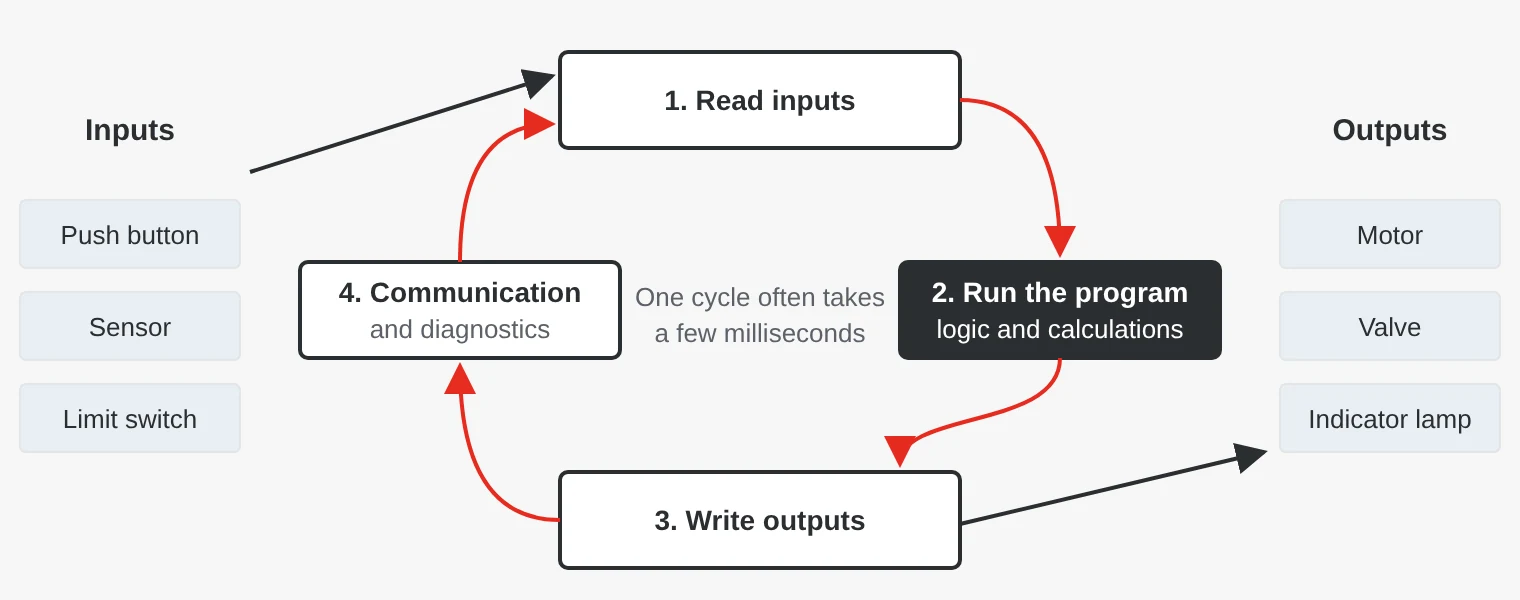
The cycle time depends on program size and processor speed. A watchdog stops the PLC and puts the outputs in a safe state if a cycle takes too long. Very fast events, for example encoder pulses, are captured by interrupts or high-speed counter modules.
For communication PLCs use fieldbuses and industrial Ethernet such as PROFINET, EtherNet/IP, Modbus TCP, EtherCAT and PROFIBUS. Towards IT systems and the cloud, OPC UA and MQTT are increasingly common.
Programming languages in IEC 61131-3
IEC 61131-3 defines common programming languages for PLCs, so a technician can find their way between different brands. Most projects mix several languages.
| Language | Type | Best for |
|---|---|---|
| LD – Ladder Diagram | Graphical, looks like a relay schematic | Logic and interlocks. Easy for electricians to troubleshoot. |
| FBD – Function Block Diagram | Graphical, connected blocks | Control loops and analogue signals, such as PID. |
| ST – Structured Text | Text-based, similar to Pascal | Calculations, loops and data handling. |
| SFC – Sequential Function Chart | Graphical, steps and transitions | Sequences such as machine cycles and batch processes. |
| IL – Instruction List | Text-based, similar to assembler | Deprecated in the third edition (2013) and removed in the fourth (2025). Found in older programs. |
In Siemens STEP 7 and TIA Portal the equivalents are called LAD, FBD, SCL and GRAPH. STL roughly corresponds to IL.
Compact PLC, modular PLC or distributed I/O?
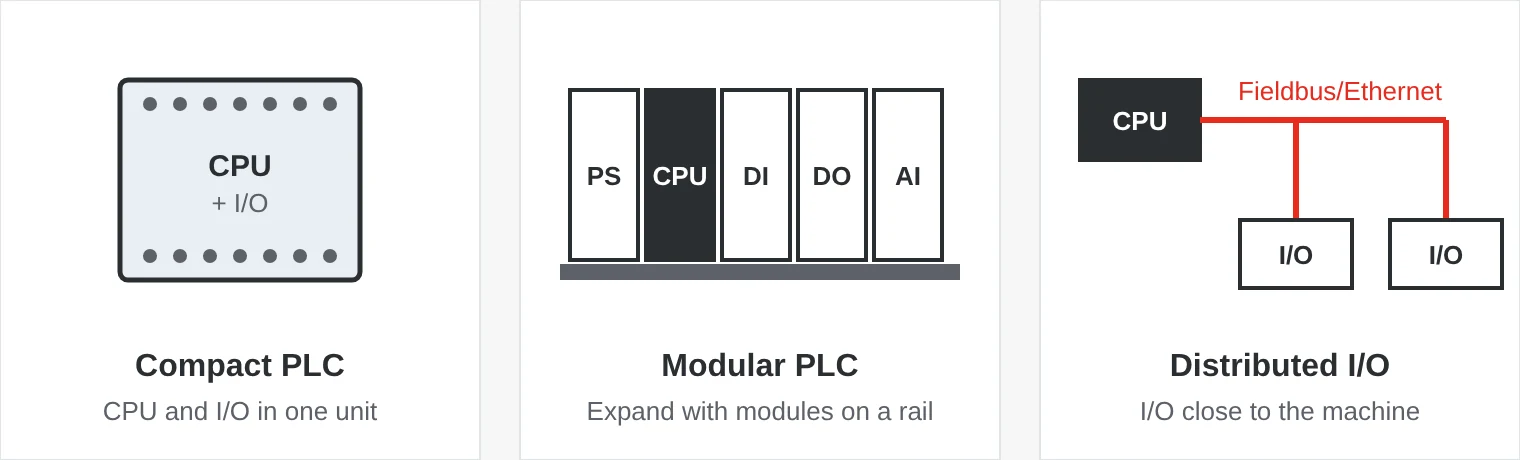
- Compact PLC – CPU, inputs and outputs in one unit, often with a few expansion modules. Suits smaller machines, pumping stations and building automation.
- Modular PLC – CPU, power supply and I/O modules on a rail or backplane. You pick exactly the modules you need and can expand later. Suits larger machines and processes.
- Distributed I/O – I/O stations out at the machine, connected to the CPU over fieldbus or Ethernet. Saves a lot of cabling and makes modular machine design easier.
PLC, PC-based control or microcontroller?
| Solution | Strength | Best when |
|---|---|---|
| PLC | Robust, predictable cycle time, easy troubleshooting and long service life | Machines and processes that run for many years and are maintained by technicians |
| PC-based control | Plenty of computing power. Control, HMI, vision and database on one computer | Advanced motion control and data-heavy applications |
| Microcontroller | Low unit cost in large series | High-volume products where you design and certify the electronics yourself |
A safety PLC handles emergency stops, guard doors and light curtains. It has dual channels and self-diagnostics and is certified for, for example, SIL 3 to IEC 61508 or PL e to EN ISO 13849-1. Safety signals can share the network with other data using protocols such as PROFIsafe and FSoE.
How to choose a PLC – five pitfalls
- Too little I/O. Machines grow. Plan for 10–20 per cent spare capacity and room for more modules.
- Forgetting communication. Check which protocols the drives, panels and other machines use before you choose a CPU.
- Leaving out the software. Licences and training can cost more than the hardware. Check what is included and what upgrades cost.
- Ignoring what technicians know. Choose an environment familiar to whoever troubleshoots at three in the morning. That may mean a system programmed with the same tools as existing plants.
- Underestimating the environment. Standard PLCs are often specified for 0–60 °C. Trains, outdoor cabinets and mobile applications need a wider range, and trains also EN 50155.
PLC systems from SCN
We carry PLC systems from Yaskawa (formerly VIPA) in the Micro PLC, SLIO and 300S+ families. They can be programmed in Siemens SIMATIC Manager (STEP 7) or TIA Portal, and SLIO and Micro PLC also in Yaskawa Speed 7 Studio. We also offer CODESYS controllers from Weintek and programmable controllers and remote I/O from Moxa.
Examples from our range
 YaskawaM13-CCF0001Compact PLC with 16 DI, 12 DO, 2 AI and 2 PWM built in. Programmed in Speed 7 Studio, SIMATIC Manager or TIA Portal.View product →
 WeintekcMT-CTRL01CODESYS PLC and IIoT gateway in one – sends data via MQTT or OPC UA.View product →
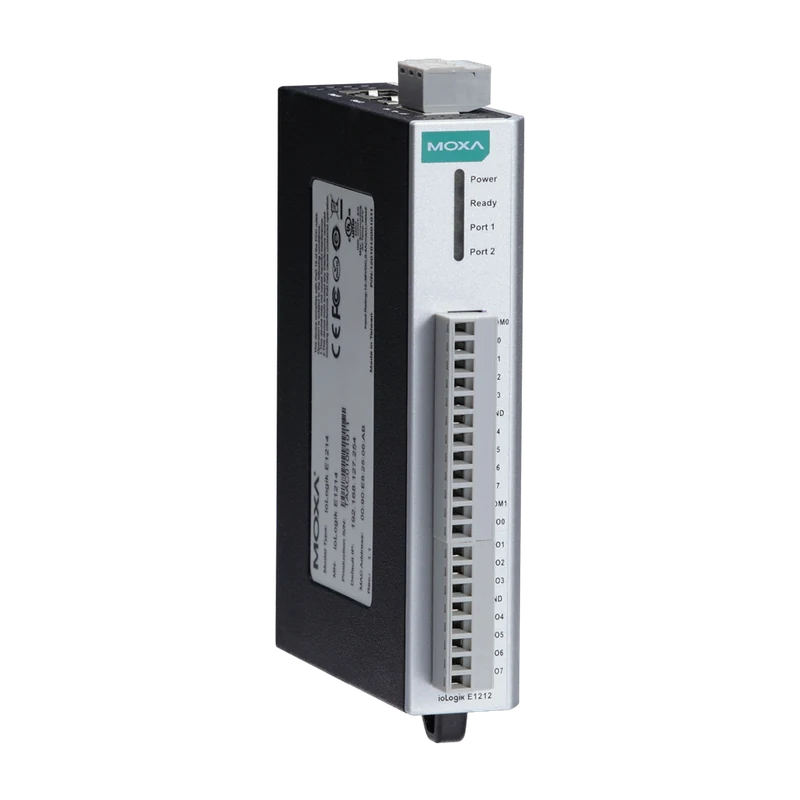 MoxaioLogik E1200 Ethernet Remote I/O ModulesEthernet remote I/O with Modbus TCP and EtherNet/IP and two ports for daisy-chaining.View product →
Erik Ahlqvist is Managing Director of SCN and has spent more than 20 years helping industrial companies choose the right electronics for demanding environments. He holds a BSc in Electronics from KTH Royal Institute of Technology, Stockholm.
LinkedIn profileFrequently asked questions
What does PLC stand for?
Programmable Logic Controller, a programmable control system for machines and processes.
Which PLC language is most common?
Ladder (LD) is still common for logic, while Structured Text (ST) is increasingly used for calculations and larger programs. Most projects mix languages.
What is the difference between a PLC and a DCS?
A DCS (Distributed Control System) is a control system for large process plants, with control, operator displays and databases integrated from the start. A PLC is more stand-alone and most common in machines and smaller plants.
Can I use a non-Siemens PLC in a Siemens environment?
Yes. There are S7-compatible PLC systems, for example from Yaskawa, that are programmed in SIMATIC Manager or TIA Portal. Check which functions and modules are supported.
What is a soft PLC?
A PLC that runs as software on an industrial computer instead of on dedicated PLC hardware. It offers more computing power but needs a computer built for industrial environments.
Building something new or replacing an older control system? Ask us – you get an answer within 24 hours.
Ask us