
U1HJ001 Ultrasonic Sensor
Ultrasonic fork sensor for label detection, IP54
Ultrasonic fork sensor for label detection, IP54
Ultrasonic sensors detect objects and measure distances using sound waves, regardless of the colour or transparency of the target. SCN supplies ultrasonic sensors in the UK1D/G2 series, available in the 0ASY, 0ESY, 1ASY and 1ESY variants. They are used for object detection, distance measurement and level monitoring in industrial automation, material handling and machine building. Our engineers help you choose the right sensing range, output and mounting for your application.

Ultrasonic fork sensor for label detection, IP54
Ultrasonic fork sensor for label detection, IP54
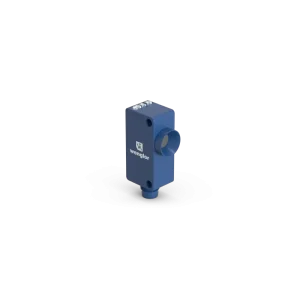
Ultrasonic distance sensor, 3 m, IO-Link, M8
Ultrasonic distance sensor, 3 m, IO-Link, M8

Ultrasonic sensor 30–400 mm, compact cuboid, IO-Link
Ultrasonic sensor 30–400 mm, compact cuboid, IO-Link

Ultrasonic sensor 30–400 mm, compact cuboid, IO-Link
Ultrasonic sensor 30–400 mm, compact cuboid, IO-Link

Ultrasonic sensor 100–1200 mm, compact cuboid, IO-Link
Ultrasonic sensor 100–1200 mm, compact cuboid, IO-Link

Ultrasonic sensor 80–400 mm, compact cuboid, IO-Link
Ultrasonic sensor 80–400 mm, compact cuboid, IO-Link

M18 ultrasonic sensor, 1.6 m, 4–20 mA, plastic, 2 m cable
M18 ultrasonic sensor, 1.6 m, 4–20 mA, plastic, 2 m cable

M18 ultrasonic sensor, 1.6 m, 4–20 mA, plastic, M12 plug
M18 ultrasonic sensor, 1.6 m, 4–20 mA, plastic, M12 plug

M18 ultrasonic sensor, 1.6 m, 4–20 mA, stainless, 2 m cable
M18 ultrasonic sensor, 1.6 m, 4–20 mA, stainless, 2 m cable

M18 ultrasonic sensor, 1.6 m, 4–20 mA, stainless, M12 plug
M18 ultrasonic sensor, 1.6 m, 4–20 mA, stainless, M12 plug

Ultrasonic sensor 100–1200 mm, M18, 0–10 V
Ultrasonic sensor 100–1200 mm, M18, 0–10 V

Ultrasonic sensor 50–400 mm, M18, 0–10 V
Ultrasonic sensor 50–400 mm, M18, 0–10 V

Ultrasonic sensor M30, 0–10 V/4–20 mA, display
Ultrasonic sensor M30, 0–10 V/4–20 mA, display

Ultrasonic sensor 50–400 mm, M30, 0–10 V/4–20 mA
Ultrasonic sensor 50–400 mm, M30, 0–10 V/4–20 mA

Ultrasonic sensor 100–1200 mm, 0–10 V/4–20 mA
Ultrasonic sensor 100–1200 mm, 0–10 V/4–20 mA

Ultrasonic sensor compact cuboid, 0–10 V/4–20 mA, display
Ultrasonic sensor compact cuboid, 0–10 V/4–20 mA, display

Ultrasonic sensor 300–6000 mm, 0–10 V/4–20 mA
Ultrasonic sensor 300–6000 mm, 0–10 V/4–20 mA
An ultrasonic sensor sends short sound pulses above the audible range and measures the time until the echo returns from the object. From the time of flight it calculates the distance, so it detects glass, liquids, granulate and shiny or black surfaces that confuse optical sensors, and it is not affected by dust, mist or colour. Typical uses are level in tanks and silos, distance and position measurement, roll diameter and object detection on conveyors. SCN supplies ultrasonic sensors from Wenglor and the UK1D/G2 series.
The range covers measuring ranges from a few millimetres in a fork sensor up to 6,000 mm, in compact cuboid, M18 and M30 housings. Many models have IO-Link together with 4–20 mA or 0–10 V analogue outputs or PNP/NPN switching outputs, IP67 or IP68 protection and M12 connectors, and some have stainless steel 316 housings. For short distances and very fast detection, see photoelectric sensors; all sensor types are under Sensors.
How to choose: start with the distance to the object and the size and surface of the target, then the housing that fits your mounting. Choose an analogue output for continuous level or distance, a switching output for presence, and IO-Link if you want to set and monitor the sensor from the PLC.
An ultrasonic sensor works by echo. A piezo transducer sends a short sound pulse and then listens for the reflection from the object. The distance is half the time of flight multiplied by the speed of sound, about 343 m/s in air at 20 °C. Because the speed of sound changes with air temperature, industrial sensors compensate for temperature to keep the reading accurate.
Mount the sensor above the liquid, pointing straight down, and it measures the distance to the surface without contact; the PLC converts distance into level or volume. Keep the beam clear of the tank wall and inlets, respect the blind zone in front of the sensor and choose an IP67 or IP68 model with 4–20 mA or IO-Link output. Heavy foam can weaken the echo.
Industrial ultrasonic sensors are typically sealed to IP67, and some to IP68, so they withstand washdown, rain and temporary immersion; the Wenglor models in the range are IP67 or IP68. Droplets or condensation directly on the transducer face can still disturb the measurement, so angle or shield the sensor where splashing is constant.
Ultrasonic sensors are used wherever the object is transparent, liquid, dark or dusty. Typical applications are level in tanks and silos, presence of glass bottles and film, roll diameter for winding control, stack height, distance to vehicles and loads, and filling level on conveyors. Ranges up to 6 m and analogue or IO-Link outputs cover most of these tasks.
Not sure which model you need?
Get help choosingFacts and advice that make the choice easier.
IP ratings explained – IP65, IP67, IP68 and IP69KAll guides
If you have questions about our products the AI-assistant can help guide you to what you are searching for.


