




Pressure transducer vs transmitter vs switch – how to choose
A pressure sensor turns the pressure of oil, air, water or gas into an electrical signal. Here is how a transducer, a transmitter and a pressure switch differ, what accuracy really covers and how to avoid common mistakes.
 By Erik Ahlqvist, Managing Director of SCN · Updated 24 October 2026 · 7 min read
- Reference – first decide what the pressure is compared with: ambient air (gauge), vacuum (absolute) or another pressure (differential).
- Transmitter or switch – a transmitter gives a measurement signal such as 4–20 mA, 0–10 V or CAN. A pressure switch only changes a contact at a set pressure.
- Range – as a rule of thumb, normal pressure should sit at 50–75% of the range. Check the proof pressure against spikes.
- Accuracy – compare the total error over the full temperature range, not just linearity at room temperature.
- Materials – the medium decides: stainless steel, ceramic or plastic, and a seal that resists the fluid.
Gauge, absolute or differential pressure?
All pressure is measured against a reference. Gauge pressure is measured against ambient air – what you see on the gauge of a hydraulic system or air line. Absolute pressure is measured against vacuum and is used when changes in atmospheric pressure must not affect the reading, as in vacuum processes, barometric measurement and gas mixing. Differential pressure is the difference between two ports, for example across a filter, a fan or an orifice plate for flow measurement.
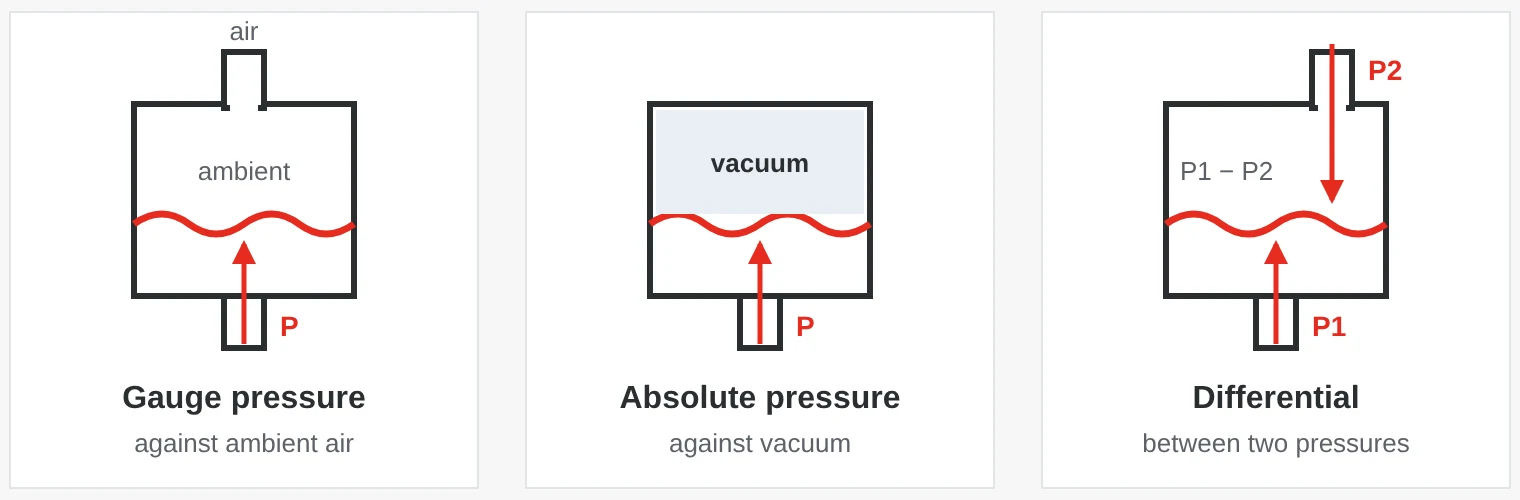
Units: 1 bar = 100 kPa = 0.1 MPa, and 1 psi is about 69 mbar. US datasheets write psig (gauge), psia (absolute) and psid (differential).
Transducer, transmitter or pressure switch – what is the difference?
- Pressure transducer – the sensing cell with a simple signal, often a few millivolts per volt of supply (mV/V). The signal needs amplifying.
- Pressure transmitter – a sensor with built-in electronics and a standard output. What most people mean by a pressure sensor today.
- Pressure switch – changes a contact when pressure passes a set point. Mechanical switches need no power supply; electronic ones often add an analogue signal.
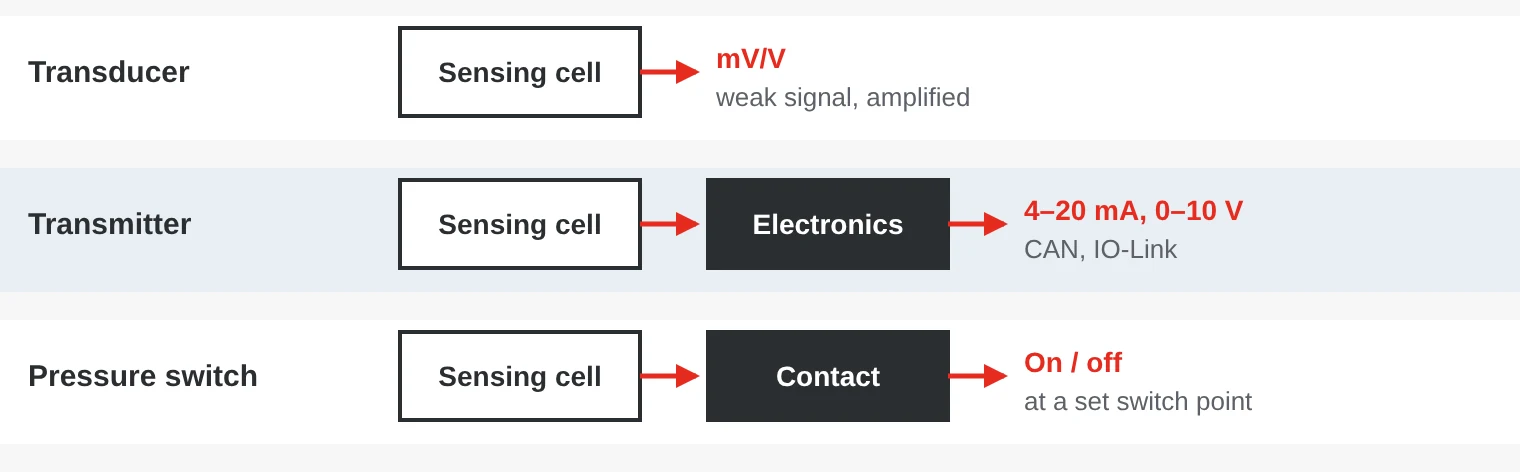
Choose a switch when you only need to know if pressure is too high or too low – low oil pressure, a clogged filter, a drop in compressed air. Choose a transmitter when the control system must regulate, log or alarm at several levels. For safety functions, switches assessed to IEC 61508 (SIL) and ISO 13849 (PL) are available.
| Output | Advantage | Keep in mind |
|---|---|---|
| 4–20 mA | Copes with long cables and interference. A broken wire shows at once, since zero is 4 mA. | Often powered over the same two wires. Check the load resistance. |
| 0–10 V | Simple to read in. | Sensitive to interference and voltage drop on long cables. |
| Ratiometric | Common in vehicles. The signal is a share of the supply, e.g. 10–90%. | The controller must use the same supply as reference. |
| CANopen, SAE J1939 | Many sensors on one bus, with diagnostics. | Set address and bus termination correctly. |
| IO-Link | Settings and diagnostics over a standard sensor cable (IEC 61131-9). | Needs an IO-Link master. |
Range, overload and pressure spikes
The range must cover normal operating pressure with a margin. Too large a range gives a bigger error in bar, since the error is a percentage of full scale (FS). ±0.5% FS is ±3 bar on a 600 bar sensor, even when you measure 20 bar.
The datasheet also gives the proof pressure, which the sensor withstands without permanent change, and the burst pressure, where it breaks. In between, it may suffer a permanent zero shift.
Pressure spikes are a common cause of failed sensors in hydraulics and water systems. When a valve closes quickly, pressure can reach several times the normal level for a few milliseconds – too fast to show on a gauge. An orifice (snubber) in the sensor port damps the peak. Cavitation, where vapour bubbles collapse, causes both spikes and erosion. Do not place the sensor directly after a pump, valve or restriction.
What does accuracy include?
Two sensors with 0.25% in the datasheet can differ a lot in practice. Check what the figure covers:
- Linearity – deviation from a straight line. Stated as BFSL (best fit straight line), the figure is lower than one measured from zero to full scale.
- Hysteresis – the signal difference at the same pressure when rising and falling.
- Repeatability – how closely repeated readings agree.
- Temperature error – how zero and sensitivity shift with temperature. Often the largest part outdoors and in mobile machines.
- Long-term stability – how much the sensor drifts per year.
The most useful figure is the total error band over the full compensated temperature range. It combines all of the above and shows how far the reading can really deviate.
Media, materials and installation
All wetted parts must withstand the medium. 316L stainless steel handles most oils, water and gases. Ceramic cells resist many aggressive media, and for ultra-pure processes and strong acids there are switches with PFA and PTFE wetted parts. Check the seal too: FKM, EPDM and NBR suit different fluids, and fully welded sensors have none.
- Wrong position on the pipe. With liquids, mount the sensor on the side of the pipe so that air does not collect at the diaphragm and sludge does not settle. With gas, mount it on top so condensate drains away.
- Blocked vent. A gauge sensor needs ambient air via the cable or a vent. If paint or water blocks it, the reading follows air pressure and temperature.
- Hot steam straight onto the sensor. A siphon or cooling tube protects the sensor from steam and media hotter than the datasheet allows.
- Over-tightened fitting. An over-tightened thread can distort the housing and shift the zero, especially on low-pressure sensors. Follow the stated torque.
Where are pressure sensors and switches used?
- Mobile machines – hydraulic pressure in cranes, forestry machines and wheel loaders for load calculation, overload protection and control.
- Factories – compressed air, lubrication, cooling water and hydraulic presses. A switch stops the machine on low oil pressure.
- Energy and water – district heating, heat pumps, pumping stations and hydropower hydraulics.
- Plastics and food – melt pressure in extruders and moulding machines, and hygienic sensors for washdown.
- Aerospace and defence – welded, hermetically sealed sensors and switches for flight controls, brakes and landing gear.
Pressure sensors and switches from SCN
We carry pressure transmitters for mobile hydraulics from Huba Control, and sensors and switches for high-purity gases, aerospace and process industry from Precision Sensors, Sensata and Nominal Controls. Tell us the medium, pressure, signal and environment, and we will help you choose.
Examples from our range
 Huba Control604 Pressure sensorDifferential pressure switch for ventilation: monitors filters and fans and protects heating coils from overheating.View product →
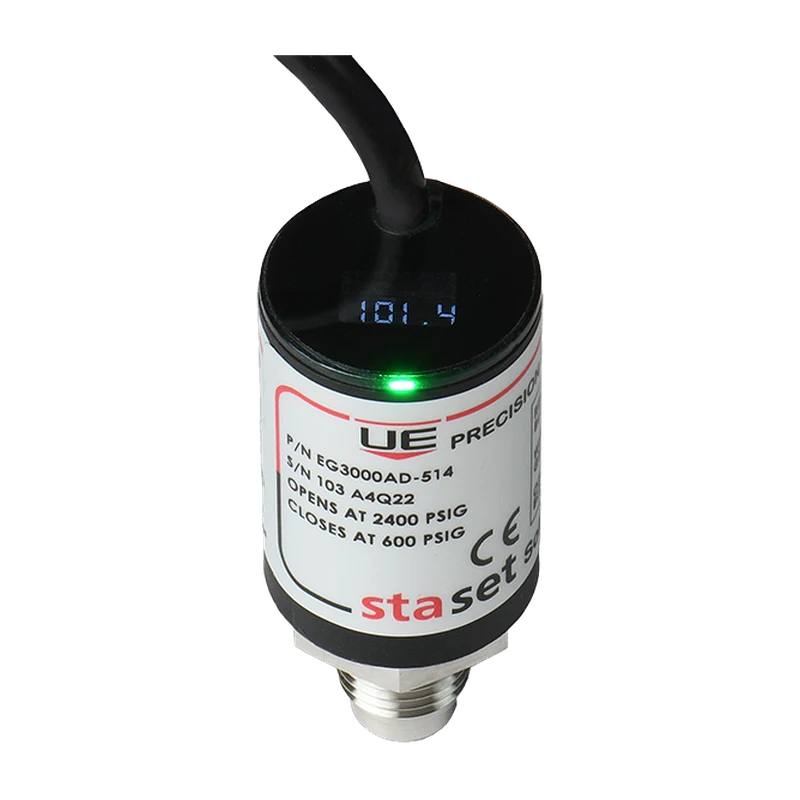 Precision SensorsStaset SIL 3 pressure switch and transducerSwitch, transducer and display in one unit. The switch output is SIL 3 capable (IEC 61508) and PL e capable (ISO 13849).View product →
 SensataPX500 Pressure TransducerPressure transducer from Sensata for −55 to 150 °C.View product →
Erik Ahlqvist is Managing Director of SCN and has spent more than 20 years helping industrial companies choose the right electronics for demanding environments. He holds a BSc in Electronics from KTH Royal Institute of Technology, Stockholm.
LinkedIn profileFrequently asked questions
What is the difference between a pressure transducer and a transmitter?
A transmitter has built-in electronics that output a standard signal such as 4–20 mA. A transducer, strictly speaking, gives a weak millivolt signal that must be amplified. In practice the terms are often mixed.
Should I choose 4–20 mA or 0–10 V?
4–20 mA copes better with interference and long cables, and a broken wire shows at once as the current drops below 4 mA. 0–10 V works well over short distances inside a machine or cabinet.
How do I choose the pressure range?
Normal operating pressure should sit at roughly 50–75% of the range, and spikes must stay below the proof pressure. Too large a range gives a bigger error in bar.
Why does my pressure sensor drift?
Common causes are spikes above the proof pressure, temperatures outside the compensated range, a blocked vent or an over-tightened fitting.
Not sure about range, signal or materials? Ask us – you get an answer within 24 hours.
Ask us