




From the Machinery Directive to the Machinery Regulation – what changes for machine builders in 2027
On 20 January 2027 the EU Machinery Regulation (EU) 2023/1230 replaces the Machinery Directive 2006/42/EC. The Regulation applies directly in every EU member state, and machinery placed on the market under the Directive before that date is not affected. The Regulation does not apply in Great Britain – but if you build machines and sell them into the EU, it applies to you. The basic principle stays the same: you are responsible for the machine. The components you choose – control systems, safety switches, switches and routers – decide how easy it is to show that the machine meets the new requirements.
 By Erik Ahlqvist, Managing Director of SCN · Updated 21 November 2026 · 9 min read
- What: EU Regulation (EU) 2023/1230 on machinery, replacing the Machinery Directive 2006/42/EC.
- When: applies to machinery placed on the EU market or put into service from 20 January 2027.
- New for control systems: they must withstand reasonably foreseeable malicious attempts by third parties that could lead to a hazardous situation.
- New for connectivity: connected devices and remote access must not lead to hazardous situations, and interventions in safety-critical software must be traceable.
- New for AI: safety functions with self-learning behaviour require assessment by a notified body.
- Instructions may be digital, but the customer can ask for paper at the time of purchase.
What changes and when?
The biggest formal change is the move from a directive to a regulation. A directive is transposed into each country’s own law. A regulation applies in the same way in all EU countries from the same day, so there is one text for the whole EU market.
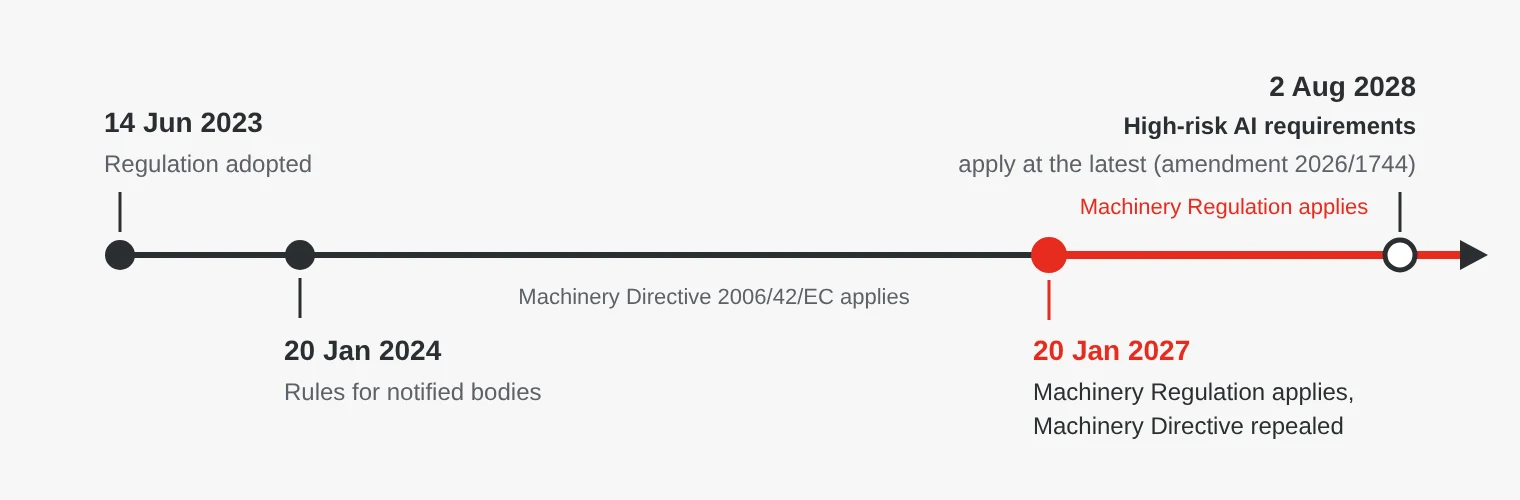
- 20 January 2027: the Regulation applies and the Machinery Directive is repealed.
- EU declaration of conformity: new model in Annex V of the Regulation. If the machine is covered by several EU acts, the manufacturer draws up a single declaration for all of them.
- Digital instructions: the instructions for use may be supplied digitally. They must be printable and downloadable and remain available online for the lifetime of the machine and for at least ten years after it was placed on the market. If the customer asks for paper at the time of purchase, the manufacturer must supply it free of charge within one month.
- The Machinery Regulation does not apply in Great Britain, where the Supply of Machinery (Safety) Regulations 2008 still apply. From 20 January 2027 they are amended so that machinery meeting the EU Machinery Regulation can also be placed on the GB market (SI 2026/867).
- In Northern Ireland the Machinery Regulation applies directly from 20 January 2027 under the Windsor Framework.
- Machines you sell into the EU from 20 January 2027 must meet the Machinery Regulation, carry CE marking under it and come with an EU declaration of conformity under the new model.
- Rules on how machinery is used at work stay national in every country – in Great Britain, for example, PUWER 1998.
Control systems and safety functions
The requirements for control systems are in Annex III, section 1.2.1. A control system must, where appropriate to the circumstances and the risks, withstand the intended operating stresses and external influences – now explicitly including reasonably foreseeable malicious attempts by third parties that could lead to a hazardous situation. A fault in the hardware or logic must not lead to a hazardous situation, and neither must reasonably foreseeable human error.
Two new traceability requirements are worth knowing:
- Tracing log: data generated by an intervention and the versions of safety software uploaded after delivery must be logged for five years after the upload. The log is used only to show, on a reasoned request from a national authority, that the machine meets the requirements.
- Self-learning control systems: for machines with fully or partially self-evolving behaviour, data on the safety-related decision-making must be kept for one year.
The established standards for functional safety of control systems are EN ISO 13849-1 and EN IEC 62061. Keep an eye on when the EU publishes references to harmonised standards under the Regulation in the Official Journal – only then do they give presumption of conformity with its requirements.
We supply PLC systems, safety PLCs, coded magnetic safety switches from Celduc and others, safety relays and relays with the safety data you need for your calculations.
Cybersecurity in the machine
The requirement for protection against corruption in Annex III, section 1.1.9 is completely new. In short:
- Connecting another device to the machine, directly or through remote access, must not lead to a hazardous situation.
- Hardware that transmits signals or data and gives access to safety-critical software must be protected against accidental and intentional corruption.
- Safety-critical software and data must be identified and protected. The machine must always be able to show which software it needs to operate safely.
- The machine must collect evidence of legitimate and illegitimate interventions in the software or its configuration.
In practice this means the same measures as in industrial cybersecurity in general: split the network into zones with managed switches, protect the boundary with secure routers, give service engineers access through VPN routers instead of open ports, and close unused USB and network ports. Components certified under an EU cybersecurity certification scheme give presumption of conformity with sections 1.1.9 and 1.2.1, as far as the certificate covers the requirements.
- Machinery Regulation: the machine builder is responsible for the safety of the whole machine, including against tampering.
- Cyber Resilience Act (CRA): the manufacturer of the component, for example the switch or router, is responsible for its cybersecurity, security updates and SBOM. The main requirements apply from 11 December 2027.
- NIS2: the operator of the plant is responsible for cybersecurity in its own organisation, under national law in each EU country.
Read more in our guides to the Cyber Resilience Act and IEC 62443 and NIS2.
AI in the machine
AI used for quality inspection or predictive maintenance, for example, is not a safety function and does not change how the machine is assessed. It is different when machine learning is used to ensure a safety function. Two categories in Annex I, Part A then require assessment by a notified body:
- safety components with fully or partially self-evolving behaviour using machine learning approaches ensuring safety functions
- machinery with such embedded systems that have not been placed on the market separately, in respect of those systems only.
An amendment in 2026, Regulation (EU) 2026/1744, requires the Commission to add the AI Act’s requirements for high-risk AI systems to Annex III of the Machinery Regulation through delegated acts. The requirements are to apply by 2 August 2028 at the latest. AI used only for user assistance or performance optimisation does not count as a safety component – AI whose failure could endanger people’s health and safety does (new paragraphs 1a and 1b of Article 6 of the AI Act).
If you run image analysis or AI models at the line, we supply edge AI computers built for industrial environments.
What you need from your component supplier
The machine builder is responsible for the machine, but the component documentation is the basis for your risk assessment and technical file. This is what you should get from your supplier:
| Component | What you need | Why |
|---|---|---|
| All components | EU declaration of conformity and datasheet | Input for your technical documentation |
| Safety components | Safety data (PL/SIL, MTTFd, PFH, diagnostic coverage) | Calculation of the safety function to EN ISO 13849-1 or EN IEC 62061 |
| Switches, routers, gateways | Certificates to IEC 62443-4-2, and to IEC 62443-4-1 for the manufacturer’s process | Shows how the component protects against tampering (section 1.1.9) |
| Products with software | Support period for security updates | The machine will run for many years – the updates must last as long |
| Products with software | SBOM, a list of the software components | Required under the CRA and the basis for vulnerability handling |
We supply components with the documentation you need. If a document is missing for a product you bought from us, ask and we will get it from the manufacturer.
When the customer rebuilds the machine
The Regulation defines a substantial modification: a physical or digital modification not foreseen by the manufacturer that creates a new hazard or increases an existing risk, and that requires new guards or protective devices affecting the safety control system, or new measures for stability or mechanical strength. Whoever carries out a substantial modification is treated as the manufacturer and takes on the manufacturer’s obligations for the machine. The modification can be digital, for example a new software version.
Checklist before 20 January 2027
- List the machines that will be placed on the EU market after 20 January 2027 – they must meet the Regulation.
- Review the risk assessment against the new requirements: protection against corruption, remote access and malicious influence on the control system.
- Plan logging of interventions and uploaded safety software versions.
- Request documentation from your suppliers: safety data, IEC 62443 certificates, update period and SBOM.
- Update your templates for the EU declaration of conformity and instructions, and decide how digital instructions will be supplied.
- Check AI functions: if machine learning is used in a safety function, a notified body is needed.
Components for safe machines
Erik Ahlqvist is Managing Director of SCN and has spent more than 20 years helping industrial companies choose the right electronics for demanding environments. He holds a BSc in Electronics from KTH Royal Institute of Technology, Stockholm.
LinkedIn profileFrequently asked questions
Does the Machinery Regulation apply to machines already sold?
No. Machinery placed on the market under the Machinery Directive before 20 January 2027 may still be sold and used. The Regulation applies to machinery placed on the market or put into service from that date, and to machinery that is substantially modified.
Do I have to replace components in my machines?
Not automatically. The Regulation sets requirements for the machine, not for each component. But new machines must meet the requirements for control systems and protection against corruption, and that is easier with components that come with safety data, IEC 62443 certificates and a long support period for security updates.
Does the Machinery Regulation apply in the UK and Norway?
It does not apply in Great Britain, but from 20 January 2027 machinery that meets it can also be placed on the GB market, and anyone selling machinery into the EU must comply with it. In Northern Ireland the Regulation applies directly. In Norway, EEA Joint Committee Decision No 171/2025 brings the Regulation into the EEA Agreement, subject to approval by the Storting, and a new Norwegian machinery regulation is proposed to apply from 20 January 2027.
Will paper instructions disappear?
Instructions for use may be digital, but the customer can ask for them on paper free of charge at the time of purchase. For machinery that can be used by consumers, the safety information must always be supplied on paper.
How long must logs be kept?
The tracing log of interventions and uploaded safety software versions must be available for five years after the upload. For self-learning control systems, data on safety-related decisions must be kept for one year.
This is general guidance, not legal advice. The full Regulation is available on EUR-Lex: Regulation (EU) 2023/1230.
More guides
All guides →Want to know which documentation is available for a specific component? Ask us – reply within 24 hours on weekdays.
Ask us