




PT100 vs thermocouple – how to choose a temperature sensor
PT100s and thermocouples are the most common ways to measure temperature in industry. This guide explains how they work, how accurate they are and how to choose the sensor, wiring and thermowell.
 By Erik Ahlqvist, Managing Director of SCN · Updated 24 October 2026 · 7 min read
- PT100 – accurate and stable, usually up to 600 °C. The first choice in process plants, food, heating and ventilation.
- Thermocouple – handles higher temperatures, above 1,000 °C, and responds quickly. Accuracy is lower.
- Accuracy – a class A PT100 is within ±0.35 °C at 100 °C. A class 1 type K thermocouple is within ±1.5 °C.
- Wiring – connect a PT100 with three or four wires. Otherwise you also measure the cable resistance.
- Transmitter – a transmitter converts the signal to 4–20 mA or IO-Link, which copes with long cables.
How PT100s and thermocouples work
A PT100 is a resistance temperature detector (RTD). A platinum resistor has 100 Ω at 0 °C, and its resistance rises by about 0.39 Ω per degree. At 100 °C it is 138.5 Ω. The instrument passes a small current through the resistor and calculates the temperature. A PT1000 works the same way but has 1,000 Ω at 0 °C. The characteristics are defined in IEC 60751.
A thermocouple is two wires of different metals welded together at the tip. When the tip and the other end, the reference junction, are at different temperatures, a small voltage appears – about 41 µV per degree for type K. The instrument measures the reference junction temperature and corrects for it, known as cold junction compensation. The types are defined in IEC 60584-1.
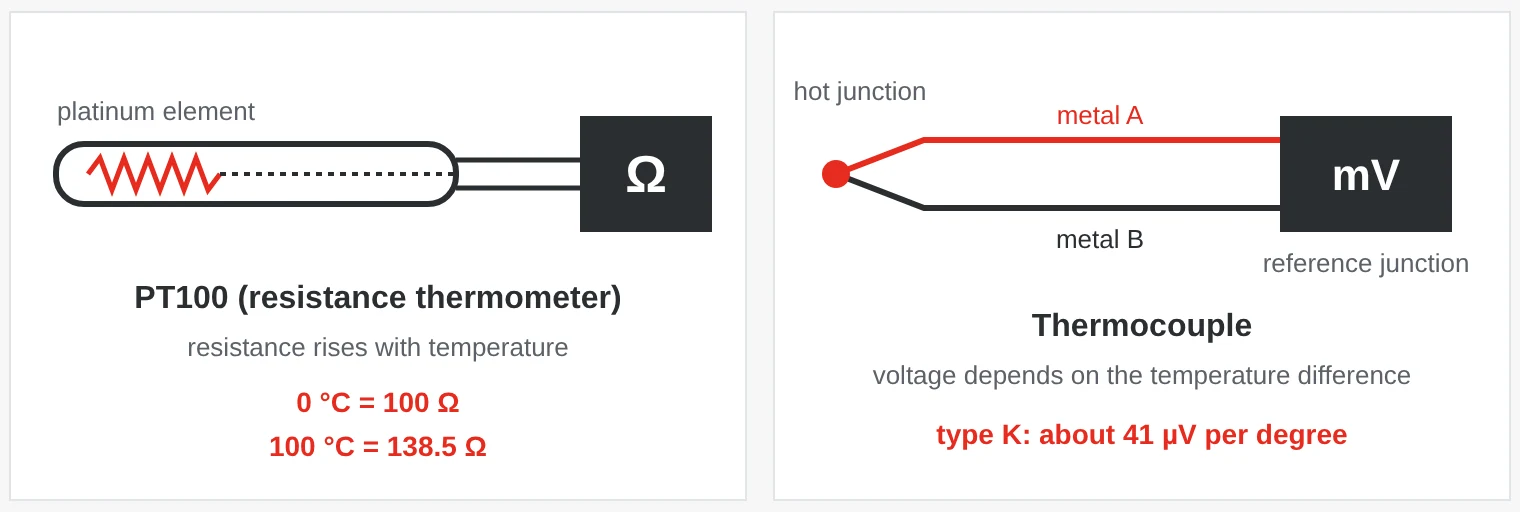
PT100 or thermocouple – which should you choose?
| Property | PT100 | Thermocouple |
|---|---|---|
| Temperature | Usually −200 to +600 °C | Up to about 1,700 °C depending on type |
| Accuracy | High: class A ±0.35 °C at 100 °C | Lower: type K class 1 ±1.5 °C |
| Stability | Very good over time | Drifts more, especially at high temperatures |
| Response time | Longer, the element is larger | Short, the tip can be very thin |
| Cable | Standard copper cable with 3 or 4 wires | Compensating cable of the same type |
| Price | Slightly more expensive element | Low-cost element |
Rule of thumb: when accuracy and stability matter most and the temperature is below a few hundred degrees, choose a PT100. Above 600 °C, for fast processes or when the sensor must be very small, choose a thermocouple.
Accuracy classes and thermocouple types
IEC 60751 divides PT100 and PT1000 elements into tolerance classes. The tolerance applies to the element itself, not the whole measuring chain. Here t is the temperature in °C:
| Class | Tolerance | At 100 °C |
|---|---|---|
| AA | ±(0.1 + 0.0017·|t|) °C | ±0.27 °C |
| A | ±(0.15 + 0.002·|t|) °C | ±0.35 °C |
| B | ±(0.3 + 0.005·|t|) °C | ±0.8 °C |
| C | ±(0.6 + 0.01·|t|) °C | ±1.6 °C |
Each class only applies within a set range, which is narrower for thin-film elements than for wire-wound ones. Class A, for example, applies from −30 to +300 °C for thin film and from −100 to +450 °C for wire-wound elements. The term 1/3 DIN means one third of the class B tolerance.
Common thermocouple types
| Type | Material | Suits |
|---|---|---|
| K | NiCr–NiAl | General purpose up to about 1,200 °C: furnaces, exhaust, heat treatment |
| N | NiCrSi–NiSi | Up to about 1,200 °C, more stable than K at high temperatures |
| J | Fe–CuNi | Up to 750 °C, common in plastics machinery |
| T | Cu–CuNi | Low temperatures, refrigeration and food |
| R, S, B | Platinum–rhodium | Up to 1,600–1,700 °C: glass, steel and ceramics |
2-wire, 3-wire or 4-wire?
A PT100 measures resistance, so the cable resistance ends up in the reading too. With a 2-wire connection and ten metres of cable with 0.5 mm² conductors, the error is almost 2 °C.
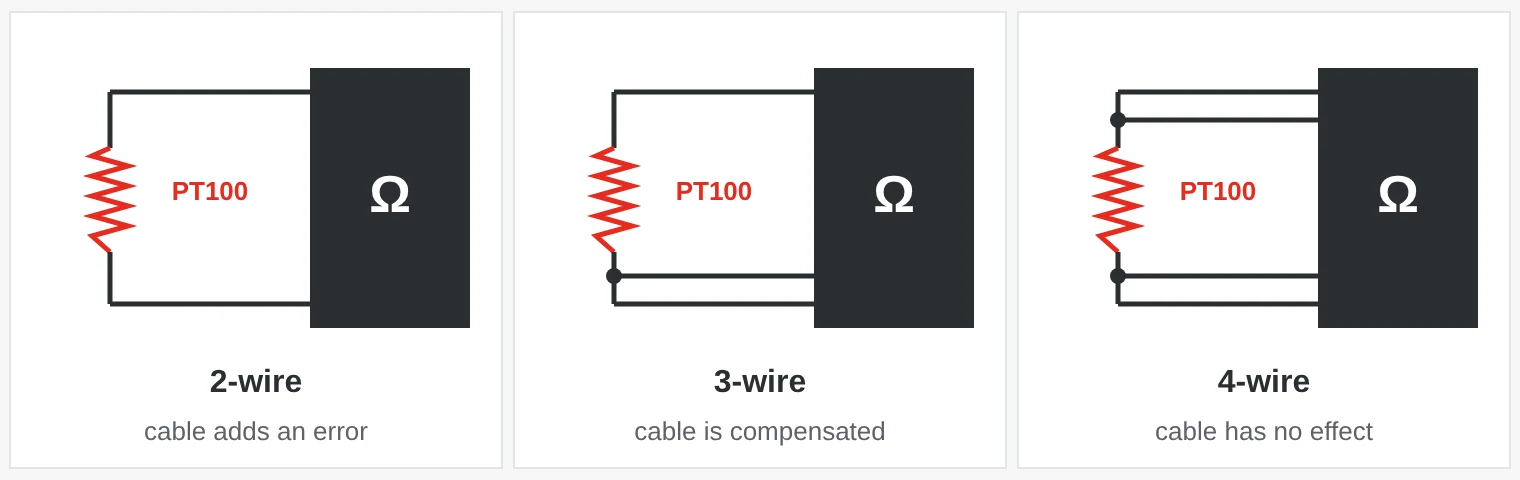
- 2-wire – the simplest. Only for short cables or PT1000s.
- 3-wire – the industry standard. The instrument measures one conductor and subtracts it, provided the conductors are equal.
- 4-wire – two wires carry the current, two measure the voltage. The cable has no effect. For laboratories and calibration.
Thermocouples are not affected by cable resistance in the same way. Instead, the cable must be of the same type as the thermocouple all the way to the instrument. A joint with ordinary copper cable becomes a new measuring point.
Response time, thermowells and transmitters
Response time is often given as t0.5 or t0.9: the time until the sensor shows 50% or 90% of a temperature step. It depends more on the thermowell and medium than on the element. Flowing liquid gives a short response time, still air a long one.
A thermowell protects the sensor from pressure, flow and wear and lets you replace it without draining the process. The immersion depth must be sufficient. A common rule of thumb is at least ten times the well diameter, otherwise the well conducts heat away and the sensor reads wrong.
A temperature transmitter in the connection head or on a DIN rail converts the signal to 4–20 mA, IO-Link or fieldbus. The alternative is a PLC analogue input that reads PT100s and thermocouples directly, or a temperature relay that alarms at a limit.
- Wrong thermocouple cable. Joints with copper cable or compensating cable of the wrong type can cause errors of several degrees.
- 2-wire connection on long cables. The cable resistance adds to the reading. Use three or four wires, or a transmitter close to the sensor.
- Too little immersion. The sensor picks up the ambient temperature through the thermowell and reads wrong, especially in small pipes.
- The class only covers the element. Transmitters and input cards have their own errors. Calculate for the whole chain and calibrate it as a whole when accuracy matters.
Where are temperature sensors used?
- Food and pharma – hygienic PT100s for pasteurisation, cleaning-in-place and cold stores.
- Factories and machines – oil and cooling-water temperature, bearings and motor windings.
- Energy – district heating, heat pumps, transformers and generators in hydro and wind power.
- Furnaces and metals – type K, N or S thermocouples in hardening furnaces, foundries and glassworks.
- Vehicles and mobile machines – exhaust, coolant and hydraulic oil temperature.
- Laboratories and medical technology – 4-wire PT100s for accurate measurement and calibration.
Temperature sensors from SCN
We carry temperature sensors for liquids and gases in pipe systems from Wenglor, temperature relays from Tele Haase and I/O modules from Yaskawa and Moxa that read PT100s and thermocouples directly. Tell us the temperature, medium and signal, and we will help you choose.
Examples from our range
 WenglorFXTT001 Temperature SensorMeasures liquids and gases in closed pipe systems. Switching outputs or an analogue signal are set via IO-Link, IP68 and IP69K.View product →
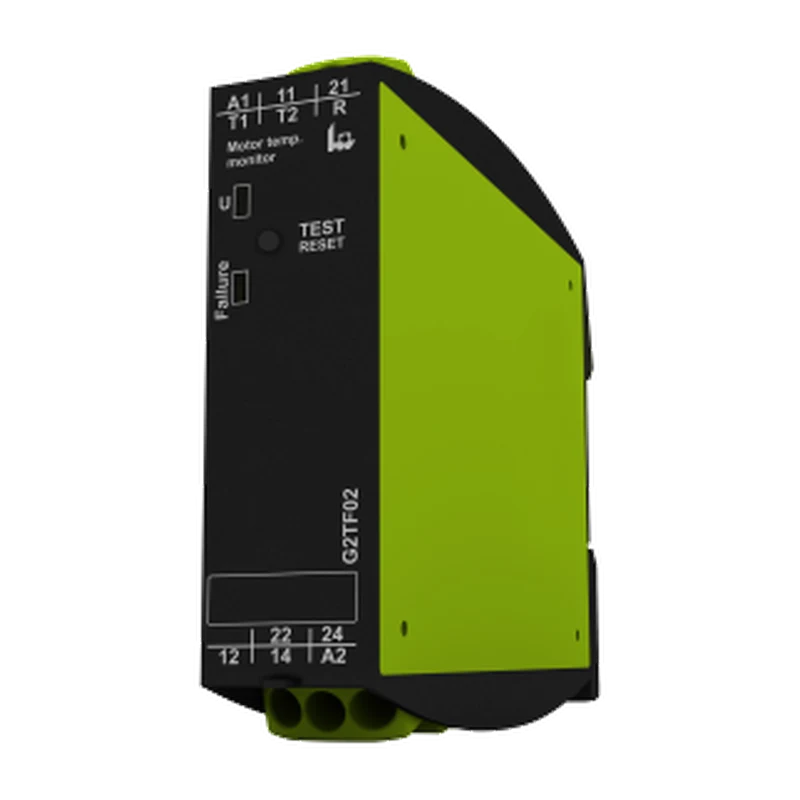 Tele HaaseG2TF / G2TMPT100 temperature monitorsDIN-rail monitor for PT100 sensors with multifunction thresholds, or for up to six PTC sensors in motor windings.View product →
 YaskawaM31-1CD50Four analogue inputs for Pt100 and Pt1000 in 2-, 3- or 4-wire connection and for type J, K, N, T and other thermocouples.View product →
Erik Ahlqvist is Managing Director of SCN and has spent more than 20 years helping industrial companies choose the right electronics for demanding environments. He holds a BSc in Electronics from KTH Royal Institute of Technology, Stockholm.
LinkedIn profileFrequently asked questions
What is the difference between a PT100 and a PT1000?
Both are platinum resistors to IEC 60751, but a PT1000 has 1,000 Ω at 0 °C. Cable resistance therefore matters less, and a PT1000 works better with 2-wire connection. The instrument must be set to the right type.
How do I check a PT100 with a multimeter?
Measure the resistance between the wires. At 0 °C it should be 100 Ω and at 20 °C about 108 Ω. A very high value points to a broken wire, a value near zero to a short circuit.
Which thermocouple type should I choose?
Type K is the general-purpose choice up to about 1,200 °C. Type N is more stable at high temperatures, type T suits low temperatures and types R, S and B the very highest.
What does 1/3 DIN mean?
A PT100 with one third of the class B tolerance, roughly ±(0.1 + 0.0017·|t|) °C. It corresponds to class AA in IEC 60751.
Why is my thermocouple reading wrong?
Common causes are the wrong compensating cable, reversed polarity, the wrong thermocouple type set in the instrument or a sensor aged by high temperature.
Not sure about sensor type, class or wiring? Ask us – you get an answer within 24 hours.
Ask us