




IEC 61850 in substations – networks, time sync and computers
IEC 61850 replaces copper wiring and proprietary protocols with Ethernet in modern substations. This guide explains GOOSE, Sampled Values and MMS – and what they demand of switches, time sync, computers and cyber security.
 By Erik Ahlqvist, Managing Director of SCN · Updated 24 October 2026 · 6 min read
- IEC 61850 – an international standard for communication in power utility automation, with a common data model and configuration language.
- GOOSE and Sampled Values – fast messages directly on Ethernet for tripping, interlocking and measurements. MMS is used for monitoring and control.
- Switches – IEC 61850-3 and IEEE 1613 show that they can handle the substation environment and interference.
- Redundancy – PRP and HSR to IEC 62439-3 keep communication running without interruption when a link fails.
- Time and security – PTP to IEC/IEEE 61850-9-3 gives microsecond time. IEC 62351 and IEC 62443 handle cyber security.
What is IEC 61850?
IEC 61850 is a series of standards for communication in power utility automation. It was developed for substations but is now also used in wind, hydro and solar power. The idea is that protection relays, control equipment and meters from different manufacturers can talk to each other without custom adaptation.
Every device, an IED (Intelligent Electronic Device), is described with a standardised data model. A circuit breaker is called XCBR and an overcurrent protection function PTOC, whatever the manufacturer. The whole station is configured with files in the SCL language (IEC 61850-6). This makes it possible to replace or add equipment without starting over.
Station bus, process bus and the protocols
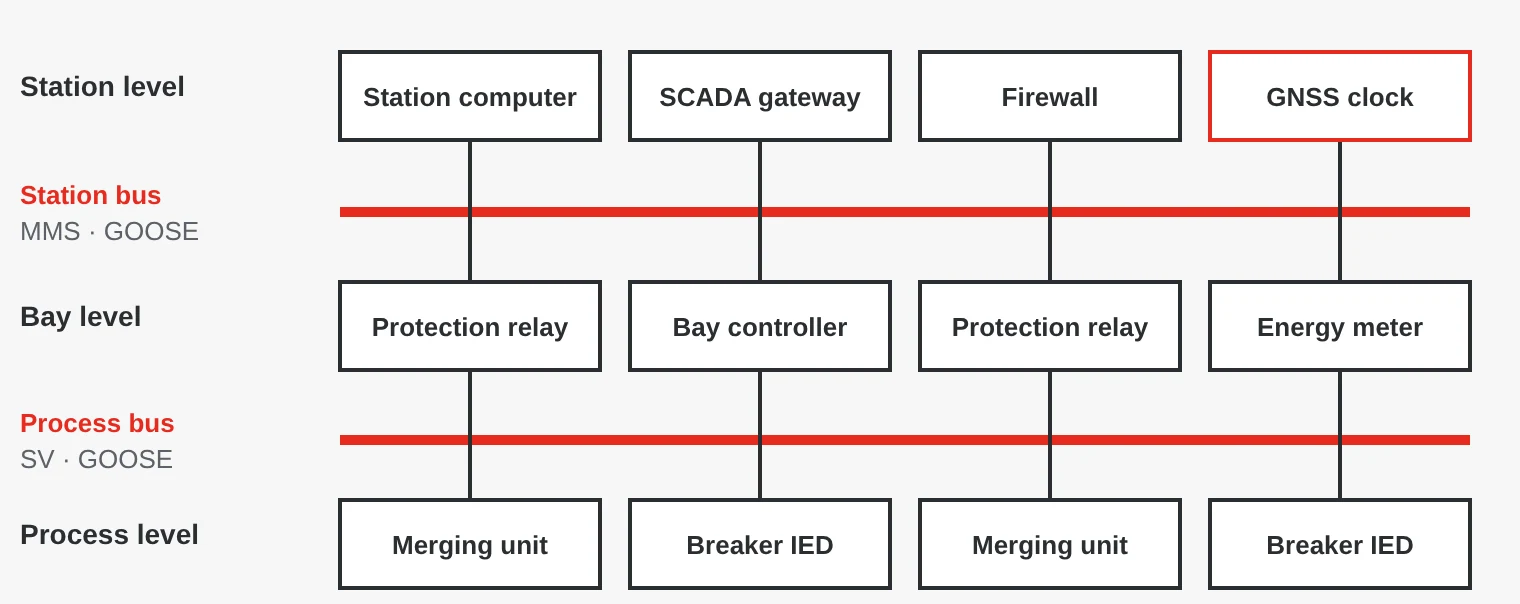
An IEC 61850 substation is divided into three levels. The station bus connects station computers and gateways with protection and control in each bay. The process bus connects the bays with the primary equipment, where merging units convert current and voltage from the instrument transformers into digital values.
| Protocol | What it does | Transport | Timing |
|---|---|---|---|
| GOOSE | Events: tripping, interlocking, position indication | Ethernet (layer 2), multicast, repeated | A few milliseconds |
| Sampled Values | Digital current and voltage values from merging units | Ethernet (layer 2), multicast, continuous | Microsecond time stamps |
| MMS | Monitoring, control, reports and files | TCP/IP, client–server | Seconds are usually enough |
GOOSE and Sampled Values are sent as multicast directly on Ethernet. Each merging unit sends thousands of Sampled Values messages per second. Switches must therefore prioritise traffic and filter multicast with VLANs, or the measurements can flood the network.
Switch requirements: IEC 61850-3 and IEEE 1613
In a substation, electronics are exposed to strong electromagnetic fields when breakers and disconnectors operate, to surges and to large temperature swings. An ordinary industrial switch is rarely enough.
IEC 61850-3 sets general requirements for substation equipment: climate, mechanics, product safety and EMC in line with IEC 61000-6-5 and IEC 60255. The North American standard IEEE 1613 has two classes. In Class 1, communication may be disturbed during the EMC tests as long as it recovers. In Class 2, it must not be interrupted or suffer errors. IEEE 1613 does not allow fans.
- Fanless design and a wide temperature range.
- Redundant power, often from the station battery.
- Support for PRP or HSR and hardware PTP.
- VLANs, prioritisation and multicast filtering for GOOSE and Sampled Values.
- Fibre ports for long distances and galvanic isolation.
Redundancy and time sync: PRP, HSR and PTP
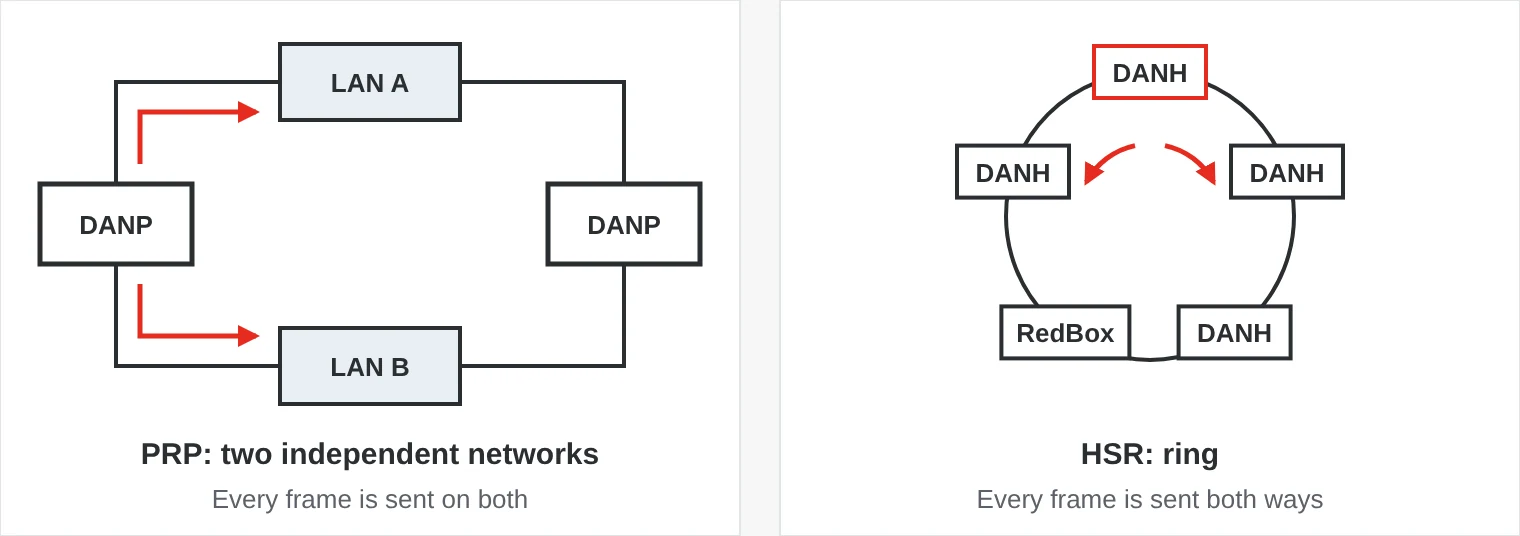
Common redundancy protocols such as RSTP need time to find a new path when a link fails. For protection and Sampled Values that is too slow. IEC 62439-3 defines two protocols with zero switchover time. With PRP, each device connects to two fully independent networks and sends every frame on both. The receiver uses the first and discards the duplicate. With HSR, devices form a ring and send each frame in both directions. Single-port devices connect through a RedBox.
Sampled Values and event logs need a common, precise time. IEC/IEEE 61850-9-3 is a PTP (IEEE 1588) profile for power utilities. It targets better than 1 µs after up to 15 switches, which requires switches with hardware PTP. Time comes from a grandmaster clock with a GNSS receiver. Choose a clock that keeps time during GNSS outages and resists jamming and spoofing.
Computers and cyber security in the substation
A substation often has a station computer with an operator display, a gateway to the utility’s SCADA and an engineering computer. If the computer will sit in the substation itself, ask for testing to IEC 61850-3 or IEEE 1613, redundant DC power and network cards with PRP. In a separate control room, an industrial rack PC is often enough.
A digital substation is also a target for attacks. IEC 62351 covers protocol security: parts 3 and 4 for TLS and MMS, part 6 for GOOSE and Sampled Values, part 8 for role-based access and part 9 for key management. IEC 62443 provides the framework of zones, conduits and security levels. In practice it starts with segmentation, a firewall towards the outside and secure remote access. The NIS2 directive also sets cyber security requirements for grid operators.
Where is IEC 61850 used?
- Transmission and distribution – new and refurbished substations.
- Renewables – collector substations in wind and solar parks, and battery storage.
- Hydro power – station and unit control.
- Industry and infrastructure – private medium-voltage networks in process industry, mines and data centres.
- Rail – traction power substations.
Five pitfalls
- Ordinary switches in the substation. Without testing to IEC 61850-3 or IEEE 1613, communication may be disturbed exactly when a breaker trips.
- Multicast without filtering. Sampled Values reach every port and fill the network. Plan VLANs before commissioning.
- Time sync as an afterthought. Switches without hardware PTP reduce accuracy with every hop.
- Redundancy that is not independent. The PRP networks need separate power and cable routes, or one fault can take out both.
- Security last. Segmentation and access control are easier to build in from the start than to add later.
Networking and time sync from SCN
We supply substation and infrastructure switches from Moxa, time servers and PTP grandmaster clocks from Protempis, and rack PCs and network appliances from brands such as Axiomtek and Winmate. The product pages list the standards stated by each manufacturer.
Examples from our range
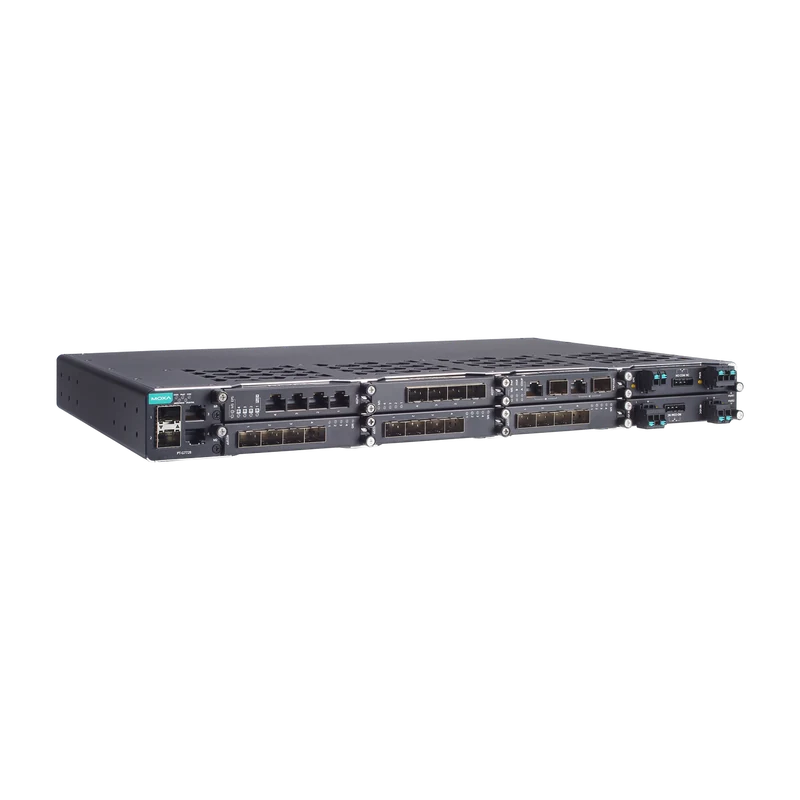 MoxaPT-G7828 28-Port Layer 3 Substation SwitchModular Layer 3 substation switch compliant with IEC 61850-3 Edition 2 Class 2, rated −40 to 85 °C, with a built-in MMS server.View product →
 ProtempisThunderbolt PTP Grandmaster Clock GM330PTP grandmaster with dual-band GNSS that resists jamming and spoofing, and keeps time during GNSS outages.View product →
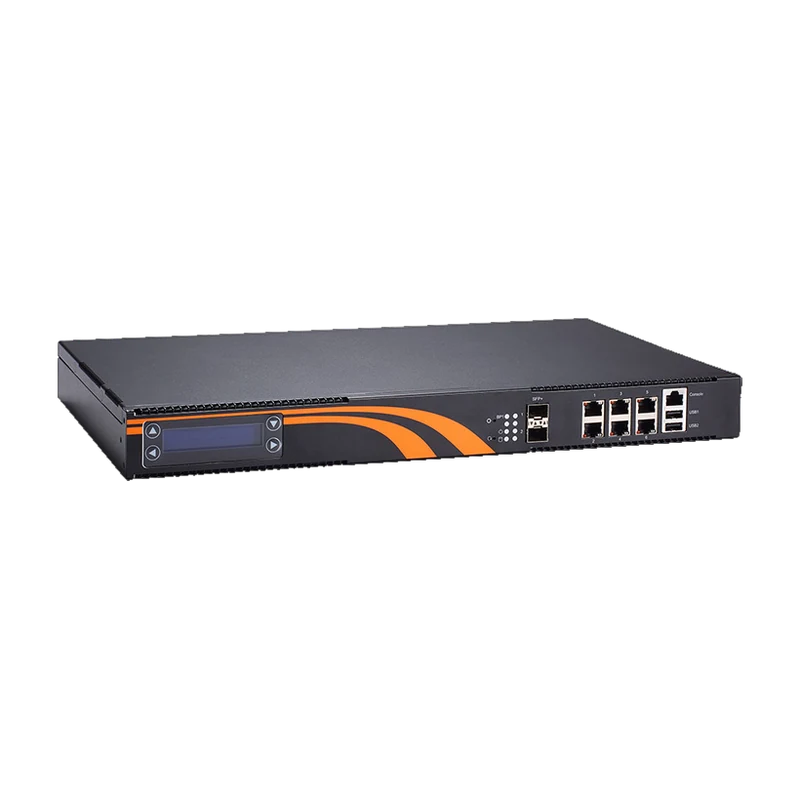 AxiomtekNA362R 1U Rackmount Appliance with 10G SFP+1U network appliance for firewall and VPN, with 10G SFP+ and LAN bypass.View product →
Erik Ahlqvist is Managing Director of SCN and has spent more than 20 years helping industrial companies choose the right electronics for demanding environments. He holds a BSc in Electronics from KTH Royal Institute of Technology, Stockholm.
LinkedIn profileFrequently asked questions
What is IEC 61850?
An international series of standards for communication in power utility automation. It defines a data model, protocols and configuration files so that equipment from different manufacturers works together.
What is the difference between GOOSE and MMS?
GOOSE sends fast events such as trips directly on Ethernet to many receivers. MMS is a client–server protocol over TCP/IP for monitoring and control.
What is a process bus?
The network between the bays and the primary equipment. It carries Sampled Values from merging units and GOOSE to the breakers instead of copper wires.
What is the difference between PRP and HSR?
PRP uses two separate networks, HSR a ring. Both send every frame twice and survive a link failure without interruption.
What does a switch need for IEC 61850?
Testing for the substation environment to IEC 61850-3 or IEEE 1613, ideally PRP or HSR, hardware PTP, and VLANs with multicast filtering.
More guides
All guides →Planning a network for a substation or a wind or solar park? Ask us – you get an answer within 24 hours.
Ask us